Money guide
Cab posture fixes that cost nothing
Why your seat setup beats any gadget
Canadian truck drivers can sit 8 to 11 hours a day. Ergonomics research has long found that sitting loads the lower back more than standing — and estimates suggest about four in five people experience back pain at some point in their lives. Before you spend money on cushions or seat upgrades, our take is simple: start with the free fixes below. Most drivers set their seat once, years ago, and never touch it again. If you do end up shopping, our seat-cushion buying guide for Canadian truck drivers compares the three main cushion types.
How this guide was made: This is a research-based guide built from published ergonomics guidance — including the Government of Canada’s Ergo-Tips for long-haul truck drivers, Manitoba trucking’s musculoskeletal-injury prevention tips for drivers, and published physiotherapy sources. We did not test anything hands-on. These are positioning and habit fixes for daily comfort — not medical treatment. Nothing here costs money.
Fix 1 — Seat height + pedal reach (the foundation)
If your seat is too low or too far back, your whole body compensates — slouching, reaching, craning.
Do this:
- Raise the seat until your hips are level with or slightly above your knees, thighs supported, no pressure digging in behind your knees.
- Slide forward or back so you can press every pedal fully with a slight bend still in your knee. If you lift your back off the seat to reach a pedal, you’re too far away.
- Leave a two-finger gap between the backs of your knees and the seat edge so circulation isn’t pinched.
- Empty your back pockets before you sit — a wallet or phone tilts your pelvis and strains your spine sideways.
Biggest mistake: sitting too far from the pedals, then creeping forward off the backrest all day.
Fix 2 — Backrest + lumbar with what you have
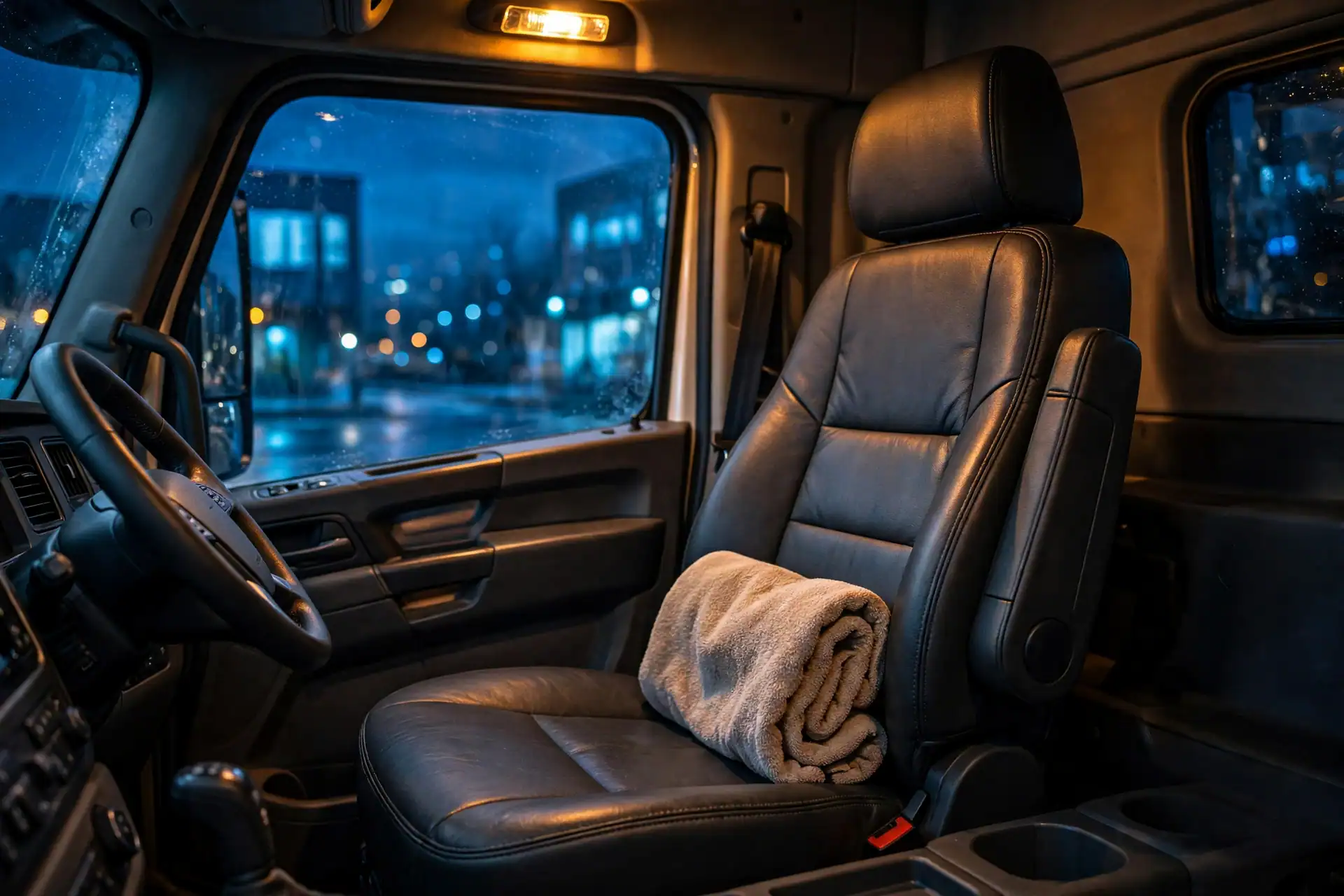
Sitting flattens the natural curve in your lower back, and that flattening loads your spine. Ergonomics guides rank lumbar support among the highest-value changes you can make in the cab — and a rolled towel does it.
Do this:
- Recline the backrest slightly — roughly 100 to 110 degrees, not bolt upright, not lounging. Slight recline absorbs road shock without hurting your view of the road.
- Put support at the belt-line curve of your lower back. No built-in lumbar? The Government of Canada’s Ergo-Tips specifically recommend a rolled towel secured behind you at the curve.
- Aim for gentle contact, then back off slightly. If it feels like a hard lump pushing you forward, it’s too much or too high.
- Sit with your backside all the way back against the backrest. If your hips are six inches off it, the lumbar support can’t help you.
Biggest mistake: reclining way back — your head drifts forward to see the road, trading lower-back relief for neck pain.
Fix 3 — Wheel + mirrors + headrest (the neck and shoulders)
Neck and shoulder pain in the cab is almost always a setup problem. If you’re reaching, craning, or leaning, the wheel and mirrors are set for the truck — not for you.
Do this:
- Pull the wheel close enough that your upper back stays on the seat while you grip it. Elbows slightly bent (roughly 120 degrees), shoulders relaxed.
- Tilt the wheel so your wrists stay straight — don’t hunch over it in traffic; drivers tense up without noticing.
- Set every mirror from your normal driving position so you can see them with your head neutral — mirrors angled too low make you crane your neck forward all day.
- Set the headrest close: top roughly level with the top of your head, nearly touching when you sit back. It protects your neck in a hard stop — and keeps your head from poking forward daily.
Biggest mistake: mirrors angled too low. Set them once, properly, and stop leaning for them.
Comparison table
| Aspect | Fix 1: Seat height + pedal reach | Fix 2: Backrest + lumbar | Fix 3: Wheel + mirrors + headrest |
|---|---|---|---|
| Targets | Slumping, sliding forward | Lower-back flattening | Neck craning, shoulder tension |
| Time to set up | ~3 minutes | ~2 minutes | ~5 minutes |
| Redo when | Switching trucks / slip-seating | Start of each shift (check towel) | Once per truck, check monthly |
| Biggest mistake | Sitting too far from pedals | Too much lumbar, pushed too hard | Mirrors angled too low |
| Cost | $0 | $0 (rolled towel) | $0 |
The fourth fix: move before your body makes you
No setup survives eight static hours. The best posture is your next posture.
- About every 30 minutes: shift your weight, drop your shoulders, unclench your jaw and hands. Canada’s Ergo-Tips literally say to make small seat adjustments this often.
- About every hour: get out. Walk around the truck for a few minutes — it gets blood moving in your legs and gives your sitting muscles a break.
- At rest stops: a few gentle chin tucks (chin straight back, hold 5 seconds) and shoulder rolls can help ease the stiffness from an hour of forward creep. For a fuller routine, see our gentle rest-stop stretches for truck drivers.
- After a long drive: don’t jump straight into heavy lifting — walk first, lift second. Give your muscles a couple of minutes to wake up.
The verdict: what free fixes can and can’t do
They can: remove the biggest daily posture mistakes and cut the tension from reaching, craning, and slumping. Most drivers are driving a seat that was never set up for them.
They can’t: fix a worn-out seat that’s lost its structure, replace medical care for persistent pain, or undo years of damage in a week. If pain is sharp or shooting, doesn’t ease after a couple of weeks of proper setup, or you have numbness in your legs — see your doctor or a physiotherapist. Positioning is prevention, not treatment.
If you’ve dialled in the setup and still want cushioning for heat or tailbone pressure, our memory foam vs gel cushion comparison breaks down which material suits which driver.
One tip from a military-trained driver
Do the setup every time you get into a different truck — rentals and loaners included. Every cab is shaped differently, and “close enough” is what wrecks your back by Friday. Height, slide, recline, lumbar, wheel, mirrors: same order, every truck.
Frequently asked questions
How often should I redo my seat setup?
Fully every time you change trucks. In your regular truck, a quick check at shift start plus small adjustments about every 30 minutes.
My truck has no lumbar adjustment. Does a rolled towel really work?
The Government of Canada’s Ergo-Tips specifically recommend a rolled towel secured to the seat at your lower back’s natural curve. Gentle contact; back off if it pushes you forward.
How far should I recline the backrest?
Slightly back from upright — roughly 100 to 110 degrees. Bolt upright strains your spine against road shock; deep recline pulls your head forward and loads your neck.
I keep sliding forward in my seat. What’s the cause?
Usually one of three: too far from the pedals, backrest reclined too far, or seat base tilted forward. Fix pedal reach and backrest first — that usually stops it.
Related reading
- Seat Cushions for Canadian Truck Drivers — Buying Guide — when free fixes aren’t enough and you need actual cushioning
- Memory Foam vs Gel Seat Cushions — which cushion material suits which driver
- Gentle Rest-Stop Stretches for Truck Drivers — a fuller movement routine for breaks
About The Driver Gear
The Driver Gear is written by a Canadian military-trained driver with real experience operating heavy vehicles, working long days, and inspecting gear before trusting it. The aim is simple: explain the fit, power and comfort trade-offs in plain language, then show the evidence behind each recommendation.
This guide is informational only and not medical advice. If you have persistent or worsening back, neck, or shoulder pain, talk to your doctor or a physiotherapist.
Leave a Reply