Money guide
12V outlet safety: what you can safely run in your truck
Two different limits — don’t mix them up
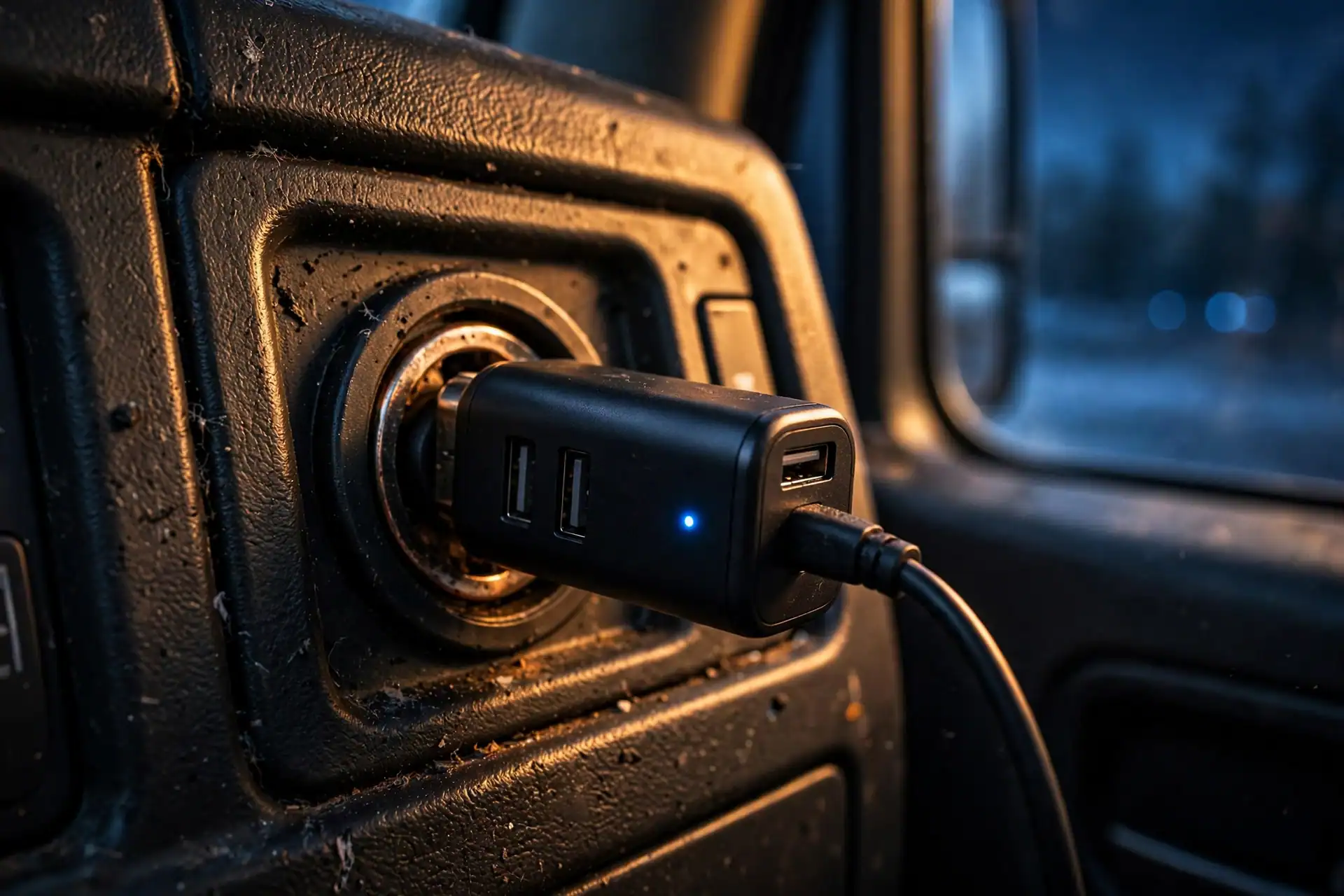
Your 12V outlet (the old cigarette-lighter socket) has two completely separate limits, and drivers confuse them constantly.
Limit 1: how much current the circuit can carry right now. The outlet sits on a circuit protected by a fuse, usually 10 to 15 amps in most vehicles (up to 20 amps in some heavy-duty trucks). Draw more than the circuit allows and the fuse blows — outlet dead until you replace it. In extreme cases, pushing a circuit too hard can heat wiring. This limit is about this instant, engine on or off.
Limit 2: how long your batteries last with the engine off. While you drive, the alternator powers everything and recharges the batteries. Parked overnight, every amp-hour comes out of the battery bank — and if the bank drains too far, the truck won’t start in the morning. This limit is about time, not the fuse.
A phone charger can be fine on both limits. A heated blanket can be fine on the fuse but dangerous on the battery if you run it all night. Keeping these two limits separate is the whole game of 12V outlet safety. The rest of this guide treats them one at a time.
The only math you need: Watts ÷ 12 = amps. A 120-watt device pulls 10 amps. A 180-watt device pulls 15 amps. Anything that needs more than that will pop a standard fuse.
How this guide was made: This is a research-based guide. We did not test these devices hands-on. Every claim below is based on published specs, manufacturer documentation, and published driver/industry sources. Electrical ratings vary by truck — check your owner’s manual and fuse panel before plugging anything in.
Limit 1: overloading the circuit
Know your actual fuse rating
“10 to 15 amps” is a range, not your number. Your truck’s fuse panel or owner’s manual lists the actual rating for the accessory circuit. Some trucks derate the outlet below the fuse number.
The number in your manual beats anything in this article.
Check it once and write it down.
The “80% rule,” qualified
You’ll hear the rule of thumb: stay under 80% of the fuse rating for anything you run continuously. On a 15-amp fuse, that’s roughly 12 amps, or about 144 watts.
Treat that as a starting point, not a standard. Safe continuous draw depends on things that change from truck to truck:
- Continuous vs peak draw. Some devices (a fridge compressor, a fan motor) briefly surge above their running draw when they start. The fuse has to survive the surges, not just the average.
- Wire gauge and circuit length. Thin or long wire runs heat up faster — the fuse may be sized for the wire, not for your device. The rule in electrical work is that the fuse protects the wire, and Blue Sea Systems’ circuit-protection guide explains why you should never change one without checking the other.
- Fuse type. A fast-blow fuse trips sooner on surges than a slow-blow type. Your truck’s manual or fuse-panel diagram may tell you which you have.
If you remember one sentence: check the manual, then stay comfortably under the listed rating.
Signs you’re pushing the circuit too hard
Warm plug, melted-looking plastic, a fuse that blows more than once, or devices that cut out under load — all signs to stop and reassess. A fuse that keeps blowing is a warning, not an annoyance. Never “fix” it with a bigger fuse (see Rule 4 below).
Limit 2: draining the battery with the engine off
Starter batteries aren’t deep-cycle batteries
Most highway trucks carry 3 to 4 large 12V batteries wired together — roughly 300–400 amp-hours total. But those are starter batteries, built to deliver a huge burst and then be recharged. They’re not deep-cycle batteries, and they don’t forgive deep drains. Drain them too far and two things happen: the truck won’t start, and repeated deep drains wear the batteries out early.
No universal runtime claims
You’ll see claims like “a 12V fridge runs X hours parked.” Ignore any fixed number. Real runtime depends on your battery bank’s size, the batteries’ age and condition, outside temperature, and what the device actually draws overnight. A new battery bank in June behaves nothing like a five-year-old bank at −20°C.
Rough numbers still help you think — just treat them as ballpark, not promises. As a working rule, plan around only half the bank’s usable capacity for parked accessories, and less if the batteries are older. The math below in the device table follows the same approach: typical draws, not guarantees. When in doubt, start the truck and recharge — that’s what the alternator is for.
Three safest high-value 12V uses
1. Phone, tablet, and laptop charging — the daily essentials
A phone charger draws roughly 10–20W (under 2 amps). A laptop charged through a small 150W plug-in inverter pulls roughly 70–90W including inverter losses — about 6–7.5 amps. Both sit comfortably under a typical 15-amp fuse.
Based on published specs and driver reviews:
- Pros: The lowest-risk thing you can do with the outlet. Negligible battery drain while driving — the alternator covers it easily. A quality 150W inverter is the biggest unit that belongs on a lighter socket (150W ÷ 12V = 12.5 amps, just under a typical fuse limit).
- Cons: A cheap, failing inverter can draw more than its label says. Charging a laptop while driving or idling is low-risk; an 8-hour parked charge is roughly 50–60Ah out of your bank depending on the laptop — real drain.
- Best for: Every driver, every day. This is what the outlet is for.
2. 12V compressor fridge with battery protection — food that stays cold
A 40–50L 12V compressor fridge draws about 4 amps while the compressor runs, but it cycles on and off — typical daily use lands around 20–30Ah in mild weather, more in heat. The key feature: most quality 12V fridges include low-voltage battery protection that shuts the fridge off before your batteries drop too far, usually with selectable cutoffs. Set it to medium or high when running off starter batteries — the low setting is meant for separate deep-cycle accessory batteries, not your starting bank.
Based on published specs and industry sources:
- Pros: Moderate draw, and the built-in cutoff is the safety net that makes this the one bigger load you can reasonably run parked. Thermoelectric coolers (the cheap kind) draw similar or higher power continuously with worse cooling — a compressor fridge is colder and more efficient. See our 12V cooler vs 12V fridge breakdown for the full comparison.
- Cons: Overnight use is still real drain — roughly 25–35Ah depending on weather and settings. Park for a full weekend without driving and even a fridge can push weak batteries too far.
- Best for: Full-time and OTR drivers who eat from the cab. Protection set to MEDIUM or HIGH, drive the next day to recharge.
3. 12V heated blanket with a timer — winter nights without idling
A typical 12V heated blanket draws 45–60W, about 4–5 amps — fine for the circuit, heavy on the battery over a full night (roughly 35–40Ah if it ran continuously). In practice, thermostatic blankets cycle, and a timer set for 2–4 hours roughly halves that.
Based on published specs and driver sources:
- Pros: The outlet handles it easily. Far cheaper than idling the engine all night — and many Canadian municipalities limit idling to 1–3 minutes, with exemptions usually only for extreme cold. Natural Resources Canada’s model idling by-law shows how the rules typically work; check your local bylaw where you park. A blanket keeps you warm where it matters: on your body, not the whole cab.
- Cons: Several amps all night will dent a starter-battery bank. Use a timer or the low setting, and don’t stack the blanket with the fridge for a two-day park on old batteries. Never use a damaged blanket, and never run one folded up — manufacturer warnings are real.
- Best for: Winter rest stops and anyone parked overnight in cold weather. Timer on, low setting, sleep warm.
The device comparison table
Draws below are typical values — your devices and your truck will vary. “Parked drain” assumes a compressor fridge cycling, not running flat out.
| Device | Typical draw | Amps at 12V | Rough parked drain | Verdict |
|---|---|---|---|---|
| Phone/tablet charger | 10–20W | ~1–1.5A | Small | SAFE — negligible drain |
| Laptop via 150W inverter | 70–90W | ~6–7.5A | Roughly 50–60Ah over 8 hrs | SAFE while driving; moderate parked |
| 12V compressor fridge (40–50L) | ~50W cycling | ~4A while running | Roughly 20–35Ah overnight | SAFE with battery protection set |
| 12V heated blanket | 45–60W | ~4–5A | Roughly 35–40Ah over 8 hrs | SAFE on the circuit; heavy overnight — use a timer |
| Dashcam / small cab fan | <12W | <1A | Small | SAFE |
| 300W+ plug-in inverter | 300W+ | 25A+ | — | BLOWS a typical 15A fuse |
| Electric kettle | 1000–1500W | 80–125A | — | NO — fuse blows; needs hardwired inverter |
| Microwave | 800–1200W | 65–100A | — | NO — fuse blows; needs hardwired inverter |
| 120V space heater | 750–1500W | 60–125A | — | NO — plus a cab fire risk; don’t improvise heat |
Where the danger line actually is
Rule 1: Nothing with a heating element goes in the lighter socket.
Kettles, microwaves, hair dryers, 120V space heaters — these pull 60 to 125 amps. The fuse blows instantly. If you need that kind of power, the answer is a large inverter wired directly to the batteries with correctly sized wire and fusing — installed by someone who does vehicle electrical. Not a plug-in unit.
Rule 2: Never plug a 300W+ inverter into the outlet.
300 watts at 12 volts is 25 amps — nearly double a typical 15-amp fuse. It will blow the fuse on the first real load. The biggest inverter that belongs on a lighter plug is ~150W, and even then, check your truck’s fuse rating first.
Rule 3: Respect the parked clock.
While the engine runs, the alternator covers everything — charge freely. Parked, every amp-hour comes from the bank. Phone chargers and a dashcam can run for a long time. A fridge overnight is fine with battery protection on. A heated blanket plus a fridge for a full parked weekend on old batteries is how you end up calling for a boost at −20°C.
Rule 4: Never modify the protection to fit the load.
Bigger fuses, bypassed fuses, rewrapped fuse wire, or tapping battery cables with hardware-store wire are how cabs catch fire. The fuse is sized to protect the wire — upgrading the fuse without upgrading the wire just moves the failure point into your wiring. If you need more than the outlet gives, get it wired properly by a shop. It’s a few hundred dollars against a burnt truck.
Rule 5: Don’t run damaged gear.
Frayed cords, cracked plugs, a heated blanket with worn spots, an inverter that smells hot — retire them. A 12V circuit is forgiving until it isn’t.
One tip from a military-trained driver
Do the math once, then label it. Take a piece of tape, write the amp draw of your gear on it, and stick it near the outlet. Phone charger: 2A. Blanket: 5A. Fridge: 4A while running. When you can see the numbers, you stop guessing — and you stop blowing fuses in truck stops at midnight.
Our verdict
For almost every Canadian truck driver, the 12V outlet safely covers the things that actually matter: charging phones and a laptop, running a compressor fridge, and keeping warm with a 12V blanket. A typical outlet’s ceiling is ~120–180W depending on your fuse — plenty for comfort, nowhere near enough for cooking or heating appliances.
The hierarchy is simple: drive and charge anything; park and run only protected loads (fridge with battery protection, blanket on a timer); never improvise a big inverter, a kettle, or extra wiring. Your batteries start the truck tomorrow morning — that’s their real job. Everything else is a guest.
Frequently asked questions
Can I run a microwave off the cigarette lighter?
No. A typical truck microwave pulls 800–1200W — that’s 65–100 amps at 12V, far beyond a 10–15A outlet fuse. It will blow the fuse immediately. Microwaves need a large inverter wired directly to the batteries with correct fusing, installed by a professional.
Will a 12V fridge kill my batteries overnight?
Not if you use its battery-protection setting — set it to medium or high on starter batteries. A 40–50L compressor fridge draws roughly 20–35Ah overnight depending on weather and settings, and the low-voltage cutoff shuts it down before the batteries drop too far. For multi-day parking without driving, the math gets tight — that’s when you check your batteries’ age and condition.
Is a 300W plug-in inverter safe on the 12V outlet?
No. 300W ÷ 12V = 25 amps, nearly double a typical 15-amp fuse. It will blow the fuse as soon as you load it. Around 150W is the practical maximum for a plug-in inverter — and check your truck’s fuse rating first.
Is it legal to idle all night to recharge the batteries?
Usually not in Canadian towns and cities — most idling bylaws limit idling to 1–3 minutes per hour, with exemptions typically for extreme cold or emergencies. The rules vary by municipality, so check the local bylaw where you park. This is context, not legal advice.
Related reading
- Our 12V cooler vs 12V fridge breakdown — the deeper dive on choosing a fridge for the cab.
- Our seat cushion buying guide — three cushions Canadian truck drivers can buy right now.
- Cab posture fixes that cost nothing — once your cab setup is sorted, fix the seat.
About the Driver Gear
The Driver Gear is written by a Canadian military-trained driver with real experience operating heavy vehicles, working long days, and inspecting gear before trusting it. The aim is simple: explain the fit, power and comfort trade-offs in plain language, then show the evidence behind each recommendation.
Electrical ratings vary by truck; when in doubt, check the fuse panel and owner’s manual.
Leave a Reply