Updated September 2026
Canadian winter
Do 12V coolers work at −40°C?
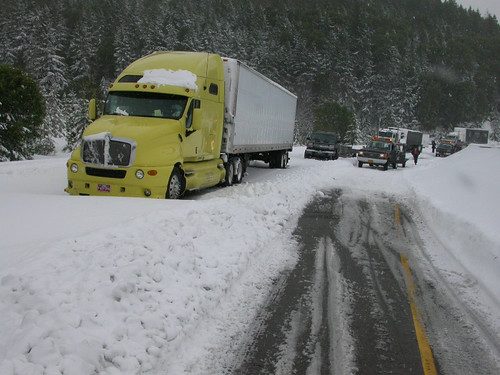
Photo: OregonDOT, CC BY 2.0, via Flickr.
Research-based. We did not test these hands-on. Scores come from published specs and driver reviews.
Short answer: it depends on which kind you bought. A compressor fridge holds the temperature you set no matter what the dash thermometer says. A thermoelectric cooler only cools relative to the air around it — exactly the wrong trick at −40°C.
#affiliate: Links go to Amazon.ca — same price to you, we may earn a commission. Prices are in CAD and can change. As an Amazon Associate I earn from qualifying purchases.
Thermoelectric: winter is where they fall apart
A thermoelectric cooler cools relative to the air around it — about 22°C below ambient, per published specs. That’s a problem with two edges in winter.
First: in a warm sleeper, it’s fine but dumb. If your sleeper is 18°C, the cooler sits at roughly −4°C. Your “cooler” is now a freezer you can’t control. Drinks burst, produce freezes, and you have no thermostat to fix it.
Second: in a cold cab, it stops being useful entirely. At −40°C ambient — say the truck is off and the cab is cold-soaked — the cooler has nothing to contribute. The Peltier module can’t heat anything up to a set temperature; some units have a warming mode, but it’s crude and power-hungry. And electronics plus extreme cold is never a kind combination: fans seize, plastics go brittle, and units left in an unheated cab overnight are the ones that show up dead in January.
Bottom line: a thermoelectric cooler in a Prairie winter is, at best, a box with a plug.
Compressor: winter is just another day
A compressor fridge works like your home fridge: you dial in 2–4°C and the compressor holds it. It doesn’t care about the delta to ambient — it just cools (or stops cooling) until the box matches the set point.
In a cold sleeper, the compressor simply runs less. Set it to 3°C in a 15°C cab and it cycles on rarely. Your food stays at food-safe temperature no matter which way the outside temperature swings — the warm spell after the cold snap, the cab warming up at a truck stop, none of it matters.
Published specs for units like the Alpicool CF55 rate the internal range down to −20°C, and the units are designed to hold a set temperature across normal ambient ranges. The one real-world caveat: at −40°C, keep the unit in the sleeper, not in an unheated cab or an exterior box. With the bunk heater running, the sleeper sits around 15–20°C — which is to say, the fridge never actually experiences −40°C.
Warm cab vs cold cab: the two winter scenarios
Warm cab — bunk heater on
The normal long-haul night: the sleeper sits 15–20°C. A compressor fridge behaves like it does in summer, cycling a little less. A thermoelectric sits around −4°C and freezes your drinks.
Compressor wins
Cold cab — truck sitting cold
Both coolers are useless for cooling — it is −40°C outside, so everything is already cold. The job is now keeping food from freezing solid: insulated bags, wraps, or bringing the cooler inside. No 12V cooler solves this one.
Winter tips that actually matter

Photo: Muffet, CC BY 2.0, via Flickr.
- Keep it in the sleeper. Not the passenger footwell, not an outside compartment — the warmest, most stable part of the truck.
- Pre-chill in the house. Load already-cold drinks before you leave. The compressor does less work and your food is cold from minute one.
- Use an insulated cover. Fitted covers cut cycling in the cold and in summer heat alike.
- Check your 12V plug and cord. Cold makes plastics brittle and connections flaky. Seat the plug firmly and recheck it the first week of cold weather.
- Never leave a thermoelectric in a freezing cab overnight. Bring it inside when the truck goes cold — electronics and −40°C are not friends.
For the full cold-weather cab setup, run through the winter cab comfort checklist.
The −40 pick: Alpicool CF55
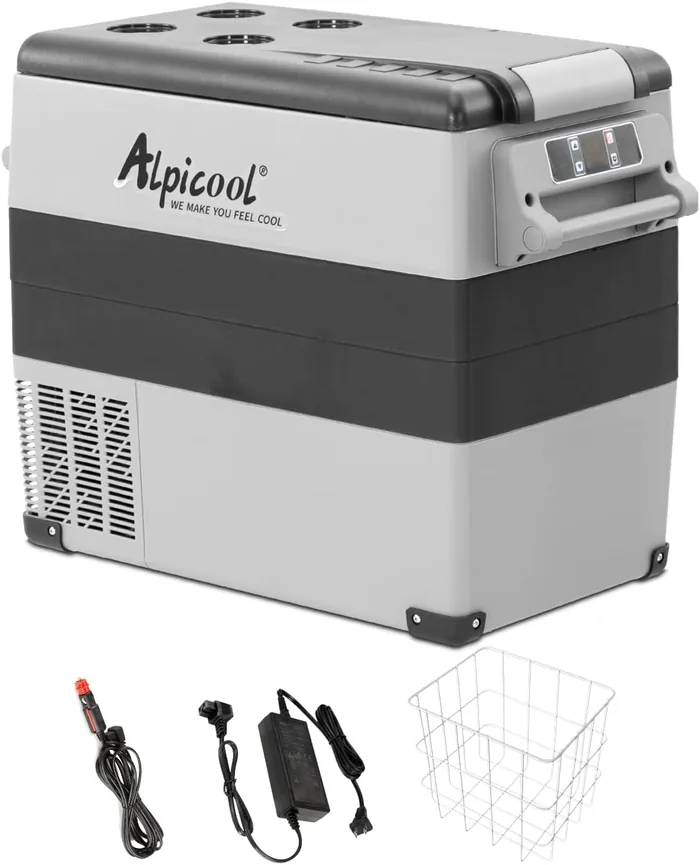
A compressor fridge that holds its set temperature in a heated sleeper all winter — see where it lands on the best 12V coolers for truck drivers shortlist.
Related reading
Best 12V coolers for truck drivers — the compressor shortlist this page keeps pointing at.
Thermoelectric vs compressor — the full head-to-head on both technologies.
Winter cab comfort checklist — the complete cold-weather cab setup.
12V guide — sockets, wiring and battery limits for powering it all.