Updated September 2026 · By Marcus Reid, The Driver Gear
Best portable power station for truck drivers in Canada (2026)
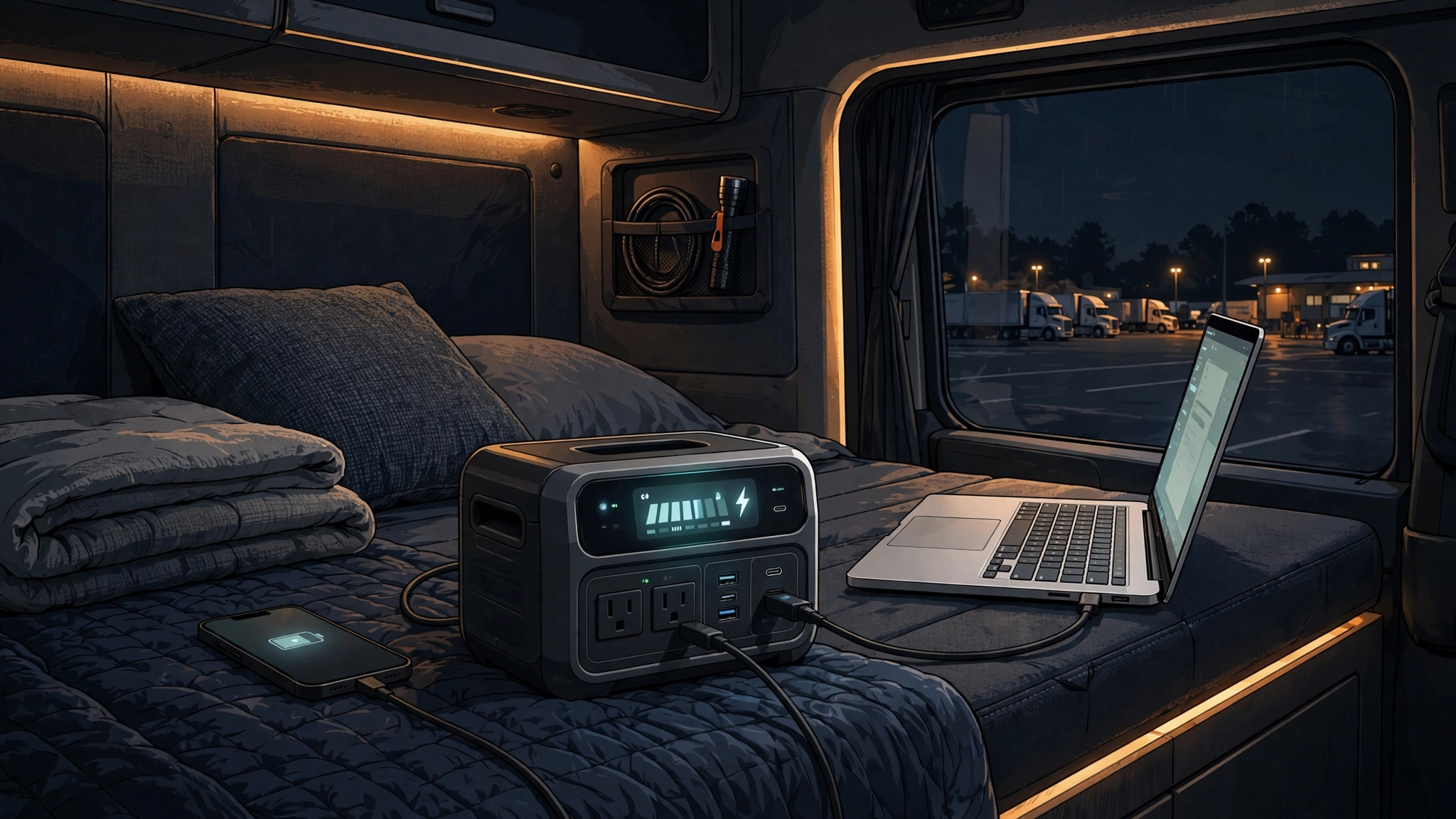
The short answer: the EcoFlow River 2 is the best portable power station for most truck drivers — 256Wh of LiFePO4 storage, 300W of AC output (600W X-Boost), and a 1-hour fast recharge. The BLUETTI EB3A is the best value alternative at a similar size, and the EcoFlow RIVER 2 Pro (768Wh) is the pick if you need to run a cooler overnight.
Research-based. We did not test these hands-on. Scores come from published specs and driver reviews. This guide contains affiliate links to Amazon.ca. As an Amazon Associate I earn from qualifying purchases. Prices are approximate, in CAD, and change often — check the live listing before you buy.
Our pick
EcoFlow River 2 — 17/20
provisional · specs + reviews
256Wh LiFePO4, 300W AC output (600W X-Boost), recharges in about an hour. Enough for a laptop, phones, lights, and a CPAP — the sweet spot for sleeper-cab life.
Quick picks
The three worth buying
Every pick below uses LiFePO4 chemistry — the safer, longer-lived battery type — and is sold on Amazon.ca.
Best overall
EcoFlow River 2
256Wh · 300W AC (600W X-Boost) · 1-hour fast charge. The balanced pick for phones, laptops, lights, and CPAP.
- Score: 17/20 provisional · specs + reviews
- Capacity: 256Wh LiFePO4
- Weight: about 3.5 kg
Best value
BLUETTI EB3A
268Wh · 600W AC (1,200W surge) · 30-minute 0–80% charging (with solar+AC). More outlets, often the cheapest of the three.
- Score: 16/20 provisional · specs + reviews
- Capacity: 268Wh LiFePO4
- Outlets: 9 total
For big sleepers
EcoFlow RIVER 2 Pro (768Wh)
768Wh · 800W AC (X-Boost 1,600W) · 70-minute fast charge. The one that can run a 12V cooler overnight.
- Score: 15/20 provisional · specs + reviews
- Capacity: 768Wh LiFePO4
- Trade-off: heavier and pricier
Why it matters
What a power station actually does in a truck
A portable power station is a big rechargeable battery with a built-in inverter and a row of outlets — AC plugs, USB ports, and usually a 12V car socket. In a sleeper cab it runs your 120V gear (laptop charger, CPAP) without idling, and it recharges from the 12V outlet while you drive.
It is not a replacement for a hardwired inverter on heavy loads: a 600W station will not run a microwave or a 1,500W kettle. What it does well is the small, steady overnight stuff — silently, with no fuel burned. Pair it with our sleeper-cab inverter sizing guide if you are deciding between the two.
Buyer’s guide
What to look for
Capacity in watt-hours (Wh). This is the size of the tank. Divide Wh by the watts of your device for rough runtime: a 256Wh station running a 45W cooler gives about 5 hours after conversion losses. Size for your longest engine-off stretch.
Inverter output in watts (W). This is how big a load it can run at once. 300W covers phones, laptops, and lights; 600W adds CPAP and small appliances. Check the surge rating too — motors and compressors spike when they start.
LiFePO4 chemistry. Lithium iron phosphate lasts far longer than older lithium-ion — typically 2,500–3,000+ charge cycles to 80% capacity, which is years of nightly use. It is also more thermally stable. Every pick in this guide is LiFePO4; treat anything else as a red flag at these prices.
Recharge speed and 12V car charging. A station you cannot refill is a paperweight. Look for fast AC charging (around an hour is the current standard) and the ability to recharge from a 12V outlet while driving.
Weight and footprint. A 768Wh station weighs roughly twice what a 256Wh one does. Measure your sleeper storage before buying big — and remember anything loose in a cab becomes a projectile in a hard brake. Strap it down.
The picks in detail
Three stations, compared honestly
Scores are provisional — based on published specs and buyer reviews, not hands-on testing.
Best overall
EcoFlow River 2
The balanced pick: enough capacity and output for a working sleeper cab, light enough to carry with one hand, and a recharge time that fits a fuel stop.
provisional · specs + reviews
- Why it wins
- Right-sized for a cab: 256Wh covers a realistic overnight of small loads without the weight penalty of bigger units.
- Fast refill: about an hour on AC means a long fuel stop or a driving shift on 12V gets you back to full.
- Watch out for
- Not an overnight cooler battery: 256Wh runs a 45W compressor cooler roughly 5 hours — fine for an evening, not a 10-hour rest. Size up to the Pro for that.
- 300W ceiling (600W X-Boost): no microwaves, no electric kettles. Check your device wattage first.
Price checked September 2026 — the listing shows the current price.
Best value
BLUETTI EB3A
Nearly the same capacity as the River 2, a true 600W continuous output — double the River 2’s 300W — nine outlets, and it is frequently the cheapest of the three on Amazon.ca.
provisional · specs + reviews
- Why it scores well
- Outlet count: nine outlets means phone, laptop, light, and CPAP can all stay plugged in.
- Often cheapest: at observed pricing it undercuts the River 2 for nearly identical usable capacity.
- Watch out for
- Heavier per Wh: about a kilogram more than the River 2 for 12Wh extra — noticeable if you carry it daily.
- Same cooler limit: 268Wh is still not an overnight cooler battery. Same 5-hour-ish math applies.
Price checked September 2026 — the listing shows the current price.
For big sleepers
EcoFlow RIVER 2 Pro (768Wh)
Triple the capacity of the base River 2 — the one to buy when a 12V cooler has to run through a full rest period.
provisional · specs + reviews
- Why it scores well
- Overnight cooler capable: 768Wh ÷ 45W ≈ 17 hours in theory — comfortably through a 10-hour rest with margin for conversion losses.
- 800W output: runs bigger loads the smaller units cannot, with 1,600W X-Boost for spikes.
- Watch out for
- Weight and size: at nearly 8 kg it needs a dedicated, secured spot — not something you move daily.
- Price jump: about double the smaller units at current prices. Only worth it if you will actually use the capacity.
Price checked September 2026 — the listing shows the current price.
Runtime math
How much station do you actually need?
Divide the station’s watt-hours by your device’s watts for a rough runtime, then knock off 10–15% for conversion losses. Some honest examples:
Phones + laptop + light (about 90W combined): in real use — charging a phone, an hour of laptop — a 256Wh unit comfortably covers an evening.
CPAP without humidifier (about 40–60W): roughly 4–6 hours on 256Wh. The humidifier can double the draw — check your machine’s rating and size up if you run it all night.
12V compressor cooler (about 45W average): roughly 5 hours on 256Wh, roughly 15 hours on 768Wh. This is the math that decides between the small units and the Pro. Our 12V cooler battery-drain calculator walks through the same arithmetic against your truck batteries.
Safety
Three rules before you buy
1. Strap it down. A 4–8 kg box becomes a projectile in a hard brake. Wedge it in sleeper storage or strap it to a fixed point — never loose on the bunk.
2. Ventilate it. Do not run a power station buried under bedding or in a sealed compartment. The inverter makes heat; give it airflow.
3. Keep it warm in winter. LiFePO4 batteries should not charge below about 0°C, and most units refuse a cold charge — a station left in an unheated side box in January simply will not recharge. Keep it in the heated cab.
How this guide was made. We compared portable power stations sold on Amazon.ca using manufacturer specifications and published buyer-review aggregates as of September 2026. Research-based. We did not test these hands-on. Scores come from published specs and driver reviews. Scores are our own, out of 20. Prices were approximate at research time and will change — the Amazon link shows the current price.
The verdict
For most drivers, the EcoFlow River 2 is the right size: it covers an evening of real sleeper-cab loads and recharges while you drive. If it is on sale below the River 2, the BLUETTI EB3A is the same job for less money. Buy the RIVER 2 Pro (768Wh) only if a 12V cooler has to run all night — that is the one job the small units honestly cannot do.
FAQ
Power station questions, answered
Can a portable power station run a 12V cooler overnight?
Only the big ones. A 256–268Wh station runs a 45W compressor cooler roughly 5 hours — not a full 10-hour rest. A 768Wh unit like the RIVER 2 Pro (768Wh) manages roughly 15 hours, which covers the night with margin.
How do you recharge a power station in a truck?
Three ways: from a 12V outlet while driving (about 2.5–3 hours for a 256Wh unit at ~100W), from a wall outlet during a rest stop with shore power, or from a portable solar panel. Most drivers just use the 12V outlet during the shift.
Will a power station drain my truck batteries?
No — that is the point. The station is its own battery. It draws from the truck’s 12V outlet while the engine runs (when the alternator handles it easily) and runs your gear from its own cells with the engine off.
Can I use a power station in a Canadian winter?
Yes — keep it in the heated cab. LiFePO4 batteries should not be charged below about 0°C, and most units will refuse a cold charge.
Power station or hardwired inverter — which should I get?
Different jobs. A power station is silent, portable, and needs no installation — best for small overnight loads. A hardwired inverter handles bigger loads but requires proper wiring and fusing. See our sleeper-cab inverter sizing guide for the full comparison.