Reviews · 12V coolers
Thermoelectric vs Compressor 12V Coolers: Which for Your Truck?
Thermoelectric coolers draw 4–5A all night and only cool below ambient. Compressor fridges sip about 1A cycling and truly freeze. Here’s the honest verdict for company trucks.
Research-based. We did not test these hands-on. Scores come from published specs and driver reviews. This guide contains affiliate links to Amazon.ca. As an Amazon Associate I earn from qualifying purchases. Prices are approximate, in CAD, and change often — check the live listing before you buy.
Key takeaways
- A thermoelectric draws 4–5A continuously. There is no thermostat, so it never cycles off — 45 amp-hours over a 10-hour stop.
- It cools below ambient, not to a temperature. About 22°C below the surrounding air: in a 35°C cab, your “cold” food sits at roughly 13°C.
- A compressor sips ~1A average. The compressor cycles, so overnight draw lands around 10 amp-hours — about one-fifth the battery use.
- Overnight outlets matter. Many company trucks cut power to the 12V outlets when the key comes out — a thermoelectric then becomes an uninsulated lunchbox by morning.
How they work
Thermoelectric: the cheap cooler with a hungry habit
A thermoelectric cooler (think Koolatron P27, a classic Canadian truck-stop fixture) uses a Peltier module — a chip that gets cold on one side and hot on the other. No refrigerant, no compressor, no moving parts except a fan.
That simplicity is the upside. They’re cheap (roughly $195 CAD at the time of writing), light, and dead reliable. There’s almost nothing to break.
The catch is power draw and performance. Published specs for the Koolatron P27 rate it at 4–5 amps (48–60W), and it draws that continuously — there is no thermostat, so it never cycles off. It also doesn’t refrigerate: it cools to about 22°C (40°F) below the surrounding air temperature, per the manufacturer’s own spec. In a 35°C July cab parked for lunch, the cooler interior sits around 13°C — pleasant for drinks, not safe for food.
How they work
Compressor: a real fridge that sips power
A compressor 12V fridge (like the Alpicool CF55) works like the fridge in your house: a compressor cycles on, pumps refrigerant, and hits whatever temperature you dial in — including true freezer temperatures down to about −20°C.
While the compressor is running, it draws roughly 45–60W, comparable to the thermoelectric. But it cycles. Owner reports consistently show the average draw lands around 1 amp (roughly 8–15W) once the box is at temperature, because the compressor only runs in short bursts.
That changes the overnight math completely.
The math
The overnight battery math
A thermoelectric at 4.5A for 10 hours pulls about 45 amp-hours from your batteries. A compressor averaging 1A pulls about 10 amp-hours — roughly one-fifth the overnight battery use.
These are estimates based on published specs and owner reports — your cab, ambient temperature, and how often you open the lid all move them around. There is also a company-policy angle: many company trucks cut power to the 12V outlets when the key comes out. A thermoelectric then just becomes an uninsulated lunchbox overnight — and a warm one by morning. A compressor fridge on a sleeper circuit (or set to a low-voltage cut-off) keeps your food cold until you wake up.
The decision
So which one should you buy?
Buy a thermoelectric only if: you’re doing day trips or regional runs where the truck is off at night, your budget is tight (under $200), and you’re storing drinks and snacks rather than food that needs true refrigeration.
Buy a compressor if: you run overnight or multi-day, you keep perishable food in the cab, or you want a freezer option. The purchase price is higher (roughly $400–600 CAD for the Alpicool CF55 class at the time of writing), but you get real refrigeration and you stop worrying about your batteries.
The units
The units behind the math
Scores are provisional — based on published specs and buyer reviews, not hands-on testing.
Compressor pick
Alpicool CF55
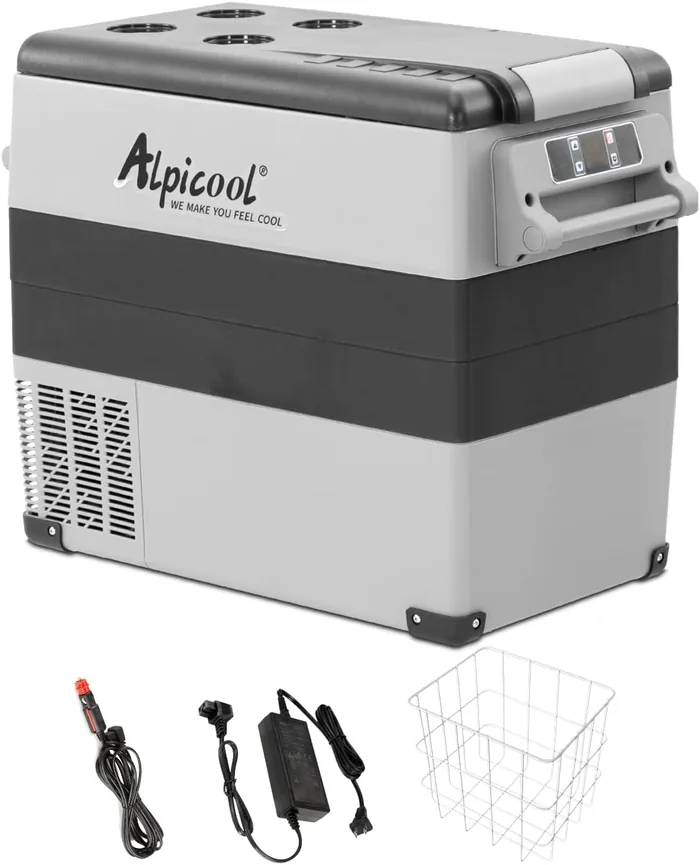
The 55 L compressor fridge used for the numbers above. Full specs and scores on the cooler roundup.
Pros
- Real refrigeration: dial in any temperature down to about −20°C — a true freezer if you want one.
- Sips power overnight: cycles on and off, so average draw lands around 1 amp — about one-fifth the battery use of a thermoelectric.
- Battery protection: most units shut down before your batteries get too weak to start the truck.
Cons
- Price: roughly $400–600 CAD for the CF55 class at the time of writing — several times a thermoelectric.
- Capacity
- 55 L
- Temperature range
- down to about −20°C
- Draw while running
- 45–60W
- Average draw
- ~1A (roughly 8–15W)
- Price
- roughly $400–600 CAD
Koolatron P27
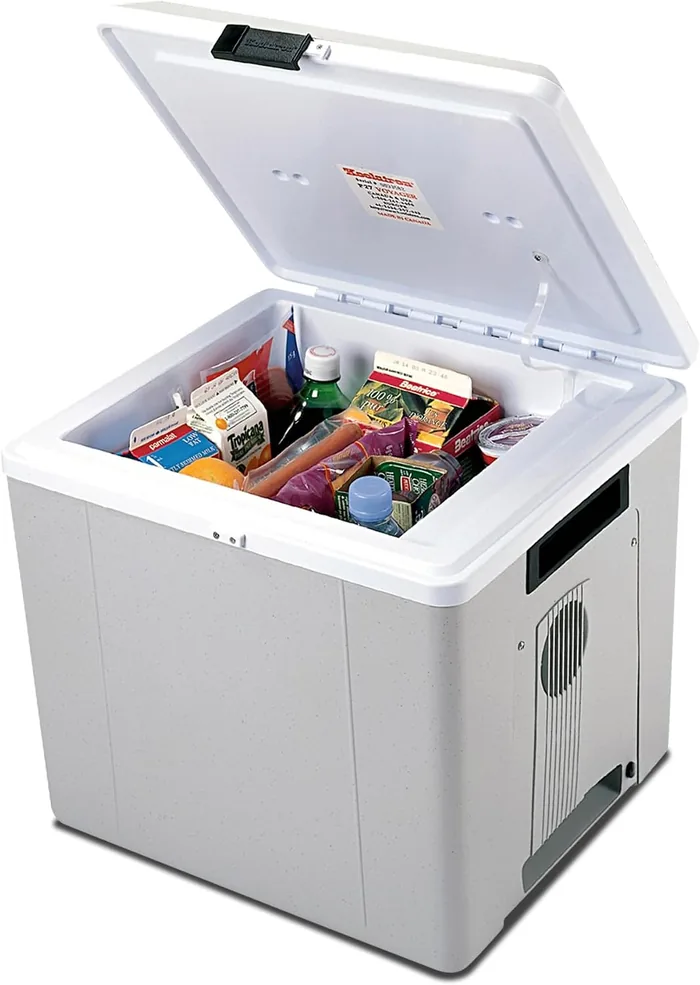
The classic Canadian truck-stop thermoelectric used for the numbers above — the honest budget option for day trips.
Pros
- Price: roughly $195 CAD at the time of writing — the cheapest way into 12V cooling.
- Dead reliable: a fan and a Peltier chip, almost nothing to break.
Cons
- 4–5A continuously: no thermostat, so it never cycles off — 45 amp-hours over a 10-hour stop.
- Not true refrigeration: cools to about 22°C below ambient — not food-safe in a hot July cab.
- Type
- thermoelectric (Peltier)
- Draw @ 12V
- 4–5A continuous (48–60W)
- Cooling
- ~22°C below ambient
- Price
- roughly $195 CAD
Side by side
Thermoelectric vs compressor at a glance
| Feature | Thermoelectric (Koolatron P27) | Compressor (Alpicool CF55) |
|---|---|---|
| Score | 14/20 | 15/20 |
| How it cools | ~22°C below ambient | set temperature, down to −20°C |
| Overnight draw (10 h) | 45 amp-hours | 10 amp-hours |
| Thermostat | none — runs continuously | cycles on and off |
| Price | roughly $195 CAD | roughly $400–600 CAD |
How this guide was made
Research-based. We did not test these hands-on. Scores come from published specs and driver reviews.
We compared thermoelectric and compressor 12V coolers using manufacturer specifications (the Koolatron P27’s 4–5A rating, the Alpicool CF55 class’s cycling behaviour) and published buyer-review aggregates as of September 2026. Scores are our own, out of 20. Prices were approximate at research time — the Amazon links show the current price.
Keep reading
Keep reading
Best 12V coolers for truck drivers
The actual units behind this math, ranked and scored.
Read the guide →
Winter
Do 12V coolers work at −40°C?
How both cooler types behave in a frozen cab.
Read the guide →
12V power
12V outlet safety: what you can safely run in your truck
What your cab’s sockets can actually run without blowing a fuse.
Read the guide →