Reviews · Cab tech
Best Dash Cams for Truck Drivers in Canada (2026)
Short answer: the VIOFO A229 Pro 2CH. It is the only pick here with 4K front recording and a supercapacitor instead of a lithium battery — the two things that matter most on a truck windshield. The working rule in this guide: parking mode only works with a hardwire installation, and a camera that shuts itself off in July heat is worthless in January court.
Research-based. We did not test these hands-on. Scores come from published specs and driver reviews. This guide contains affiliate links to Amazon.ca. As an Amazon Associate I earn from qualifying purchases. Prices are approximate, in CAD, and change often — check the live listing before you buy.
Key takeaways
- Get a supercapacitor model, not a lithium-battery one. A truck windshield is a greenhouse in summer. Supercapacitors tolerate heat and cold that swell and kill lithium cells — the two winners below both use them.
- Parking mode needs a hardwire install. A camera plugged into the 12V outlet records while you drive; parked and ignition-off, it is dead weight. Recording at the truck stop needs constant power with low-voltage protection, usually a hardwire kit.
- 4K helps, wide lenses do not. Higher resolution reads plates at distance; a wider field of view just stretches the same pixels thinner. Do not buy on field-of-view numbers.
- Dual-channel is the point for trucks. Rear-end collisions and tailgaters are a trucker’s reality — a front-only cam misses half the story. The VIOFO and Thinkware record front and rear; the Garmin X110 is front-only, which is its main trade-off.
The job
What actually matters in a truck dash cam
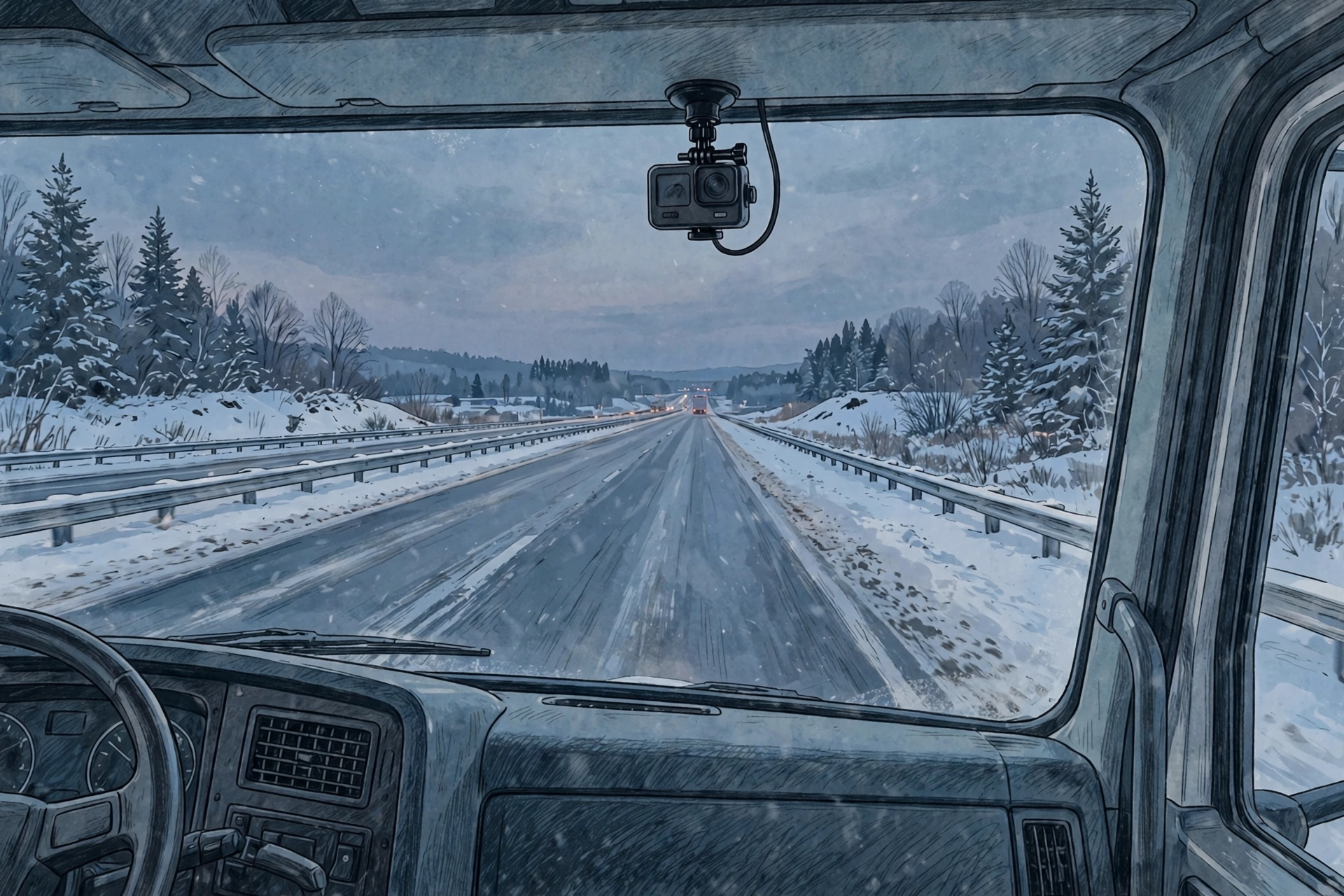
A dash cam in a car is an accessory. In a truck it is a witness — to the four-wheeler who cut across your lane, the yard incident with no one around, the disputed delivery damage. The footage only matters if the camera was running, the file was intact, and the plate was readable. Everything below follows from that.
Power source first. Cheap cameras carry small lithium batteries. Parked in July sun, a windshield easily tops 60°C — lithium swells, vents, or simply dies, and the camera with it. Supercapacitor models have no battery to cook; the capacitor holds just enough charge to finish saving the file when power cuts. For something that lives on glass year-round, this is the single most important spec, and it is why the lithium-battery pick in this guide comes with a warning.
Parking mode is an installation, not a feature. Every camera here advertises parking surveillance. Read the fine print: it requires constant power — a hardwire kit into the fuse box (with a low-voltage cutoff so it never strands your batteries) or an OBD-II power cable. A cam on the 12V outlet plug goes dark with the ignition. If you want recording at the truck stop, budget the kit and the install, not just the camera. Our 12V guide explains what a truck’s outlets can and cannot do.
Resolution beats field of view for plates. Marketing loves wide-angle numbers — 140°, 160°. Wider means each pixel covers more road, which means plates get blurrier, not sharper. The honest spec for plate capture is sensor resolution plus HDR for night headlights. A 4K sensor with good HDR reads plates a 1080p wide-angle never will.
GPS stamps your speed — plan for it. Built-in GPS embeds speed and location in the footage, which is gold when it proves you were doing the limit — and awkward when it proves otherwise. Know what your camera records before someone else reads it.
The picks in detail
Three dash cams, compared honestly
Scores are provisional — based on published specs and buyer reviews, not hands-on testing.
Best pick
VIOFO A229 Pro 2CH
True 4K front (Sony STARVIS 2) plus 2K rear, dual HDR, and a supercapacitor — the only camera here with all three. The priciest pick and the hardwire kit and SD card are sold separately, but nothing else records plates like it.
Pros
- 4K front + 2K rear, dual Sony STARVIS 2 sensors: the sharpest plate-capture in this guide, front and back.
- Supercapacitor, −20°C to 65°C operating range: built for a windshield that bakes in July and freezes in January.
- Dual HDR and 5 GHz Wi-Fi: readable plates against oncoming headlights, fast clip transfers to your phone.
Cons
- about C$450 — the most expensive pick by a wide margin.
- Hardwire kit and microSD card sold separately: parking mode and storage both cost extra.
- 2.4-inch screen and GPS mount add bulk behind the mirror — mount it high and centred.
- Front / rear
- 4K (3840×2160) / 2K (2560×1440)
- Field of view
- 140° front
- Power
- Supercapacitor (no lithium battery)
- Parking mode
- Yes — needs HK4/HK6 hardwire kit (sold separately)
- GPS
- Built in (quad-mode)
- Storage
- microSD to 512 GB (not included)
- Price
- about C$450
Thinkware Q200 2CH
2K QHD front plus 1080p rear with a supercapacitor, 12/24V support, and thermal protection — the sensible-value pick. Includes a 32 GB card, GPS antenna, and hardwire cable. Narrower 125° view and 1080p rear are the honest trade-offs.
Pros
- Supercapacitor with integrated thermal protection: the heat-safe design at a third of the VIOFO’s price.
- 12/24V input: works with a truck’s 24V system without adapters.
- 32 GB card, GPS antenna, and hardwire cable included: closer to a complete kit out of the box.
Cons
- 1080p rear camera: tailgater plates at distance will be softer than the VIOFO’s 2K rear.
- 125° field of view: narrower than rivals — fine for straight highway, less forgiving at wide intersections.
- 256 GB max card vs 512 GB on the others.
- Front / rear
- 2K QHD (2560×1440) / 1080p
- Field of view
- 125° diagonal
- Power
- Supercapacitor (no lithium battery)
- Parking mode
- Yes — hardwire cable included
- GPS
- External antenna included
- Storage
- microSD to 256 GB (32 GB included)
- Price
- about C$150–170
Garmin Dash Cam X110
A simple, trusted 1080p single-channel cam with a polarizer, GPS, and voice control. The honest catch: it runs on a rechargeable lithium battery, not a supercapacitor — unplug it on hot days and skip parking mode.
Pros
- Included Clarity polarizer: cuts windshield glare in daylight — a real, useful extra.
- Voice control and driver alerts (forward collision, lane departure, go alert) in a compact 2.4-inch-screen body.
- Garmin Drive app and Vault cloud storage: painless clip review if you already live in Garmin’s ecosystem.
Cons
- Lithium-ion battery, not a supercapacitor: the one pick here that can cook on a hot windshield — unplug it in summer and forget parking mode.
- 1080p single channel: no rear camera, no 2K/4K — the weakest evidence of the three.
- microSD not included; parking guard needs Garmin’s constant power cable plus a subscription.
- Front / rear
- 1080p / none
- Field of view
- 140°
- Power
- Rechargeable lithium-ion (up to 20 min)
- Parking mode
- Parking Guard — needs constant power cable + subscription
- GPS
- Built in
- Storage
- microSD to 512 GB (not included)
- Price
- about C$200
At a glance
Three cams at a glance
| Spec | VIOFO A229 Pro | Thinkware Q200 | Garmin X110 |
|---|---|---|---|
| Score | 16/20 | 13/20 | 12/20 |
| Front resolution | 4K | 2K QHD | 1080p |
| Rear camera | 2K | 1080p | None |
| Power source | Supercapacitor | Supercapacitor | Lithium-ion |
| Parking mode | Hardwire kit extra | Hardwire cable included | Cable + subscription |
| GPS | Built in | Antenna included | Built in |
| Card included | No | 32 GB | No |
| Price | about C$450 | about C$150–170 | about C$200 |
FAQ
Dash cam questions, answered
Do I need a dual-channel dash cam in a truck?
Strongly recommended. Rear-end incidents and tailgating are everyday trucker realities, and a front-only camera records none of it. Two of the three picks here are dual-channel; the Garmin is front-only and scored accordingly.
Will a dash cam drain my truck batteries?
While driving, no — a dash cam draws a few watts from the 12V outlet. Parked, a hardwired parking-mode camera draws a small constant current, which is why the hardwire kit’s low-voltage cutoff matters: it shuts the camera down before the batteries drop too far to start the truck.
Is 4K really worth it over 1080p?
For reading plates at distance, yes — 4K has four times the pixels of 1080p, and that is what resolves a plate 30 metres out. At close range or low speed, 1080p with good HDR is fine. Match the resolution to how far away the evidence usually is.
Can I just plug it into the 12V outlet?
For driving recording, yes — all three run from the 12V outlet. But the outlet usually dies with the ignition, so you get no parked recording. See our 12V outlet safety guide before adding anything to that circuit.
Does the GPS speed stamp cause problems?
It can. GPS embeds your speed in the footage, which helps when it shows you doing the limit and hurts when it does not. If that bothers you, all three cameras let you disable GPS — at the cost of losing location evidence too.
How this guide was made
Research-based. We did not test these hands-on. Scores come from published specs and driver reviews.
We compared dual- and single-channel dash cams sold on Amazon.ca using manufacturer specifications and published buyer-review aggregates as of September 2026, weighting power-source type (supercapacitor over lithium for cab heat), recording resolution and HDR, dual-channel coverage, parking-mode requirements, and GPS. Scores are our own, out of 20. Prices were approximate at research time — the Amazon link shows the current price.
Keep reading