Money guide
Best 12V Portable Coolers for Truck Drivers (2026)
Quick picks
Affiliate links to Amazon.ca — we may earn a commission at no extra cost to you. Research-based: we did not test these hands-on. Scores come from published specs and driver reviews.
Best overall
Dometic CFX5 35 18/20
The most reliable compressor fridge reviewers know — with a 5-year warranty.
Best for long hauls
Alpicool CF55 15/20
52 quarts (~70 cans) — maximum capacity per dollar for multi-day runs.
Best budget
BougeRV 23 Quart 16/20
Real compressor refrigeration for about C$230.
The Dometic CFX5 35 (18/20) is the best 12V cooler for truck drivers — vacuum-insulated panels, a variable-speed compressor, and a 5-year warranty. On a budget, the BougeRV 23 Quart (16/20) delivers real compressor refrigeration for about C$230. Can’t decide between the two compressor brands? See our Dometic vs BougeRV head-to-head.
Research-based. We did not test these hands-on. Scores come from published specs and driver reviews. This guide contains affiliate links to Amazon.ca. As an Amazon Associate I earn from qualifying purchases. Prices are approximate, in CAD, and change often — check the live listing before you buy.
Updated September 2026
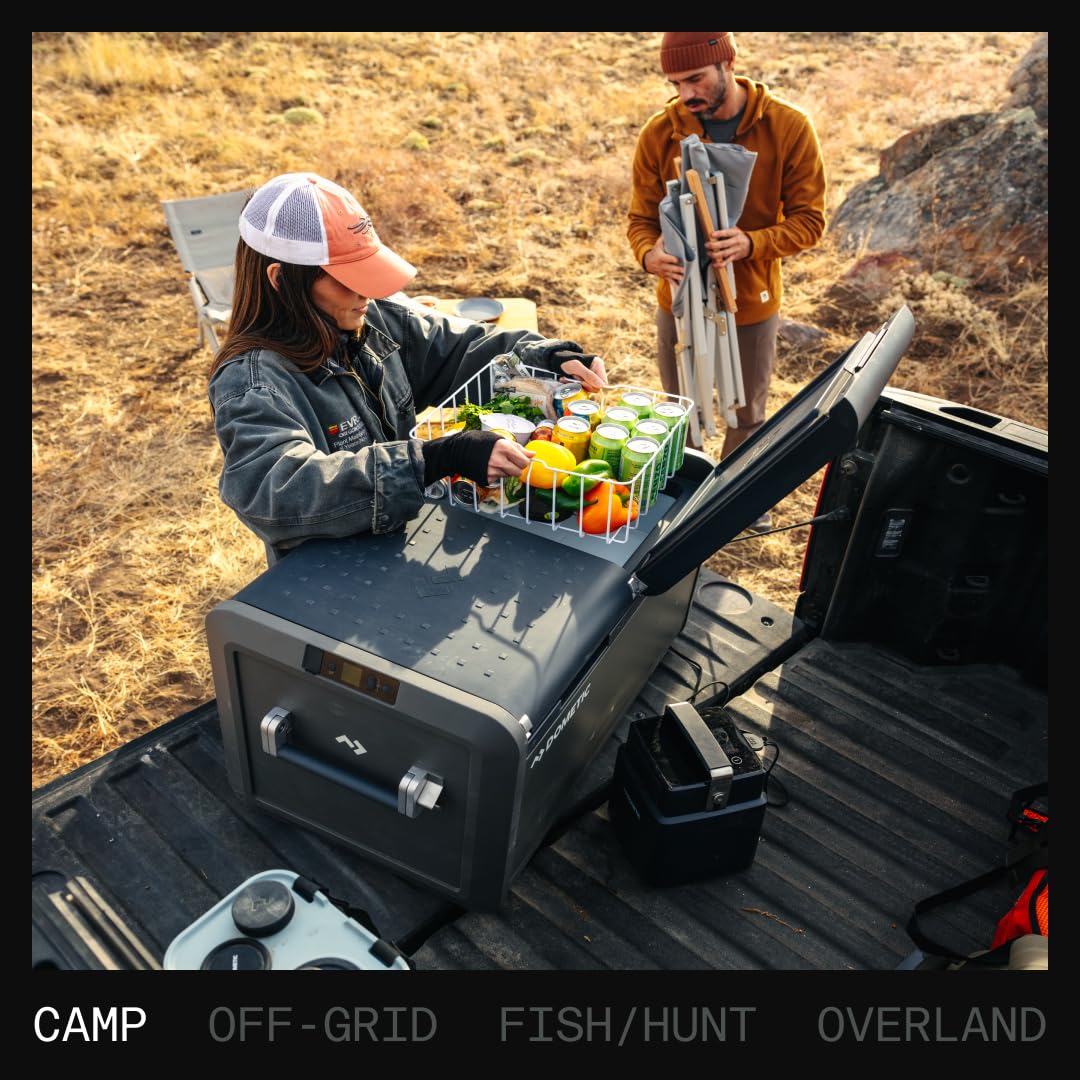
We scored the coolers below from published specs and buyer reviews. No hands-on testing — just the numbers, the features that matter in a cab, and what actual owners report. A note on wording: around 12V gear, “cooler” and “fridge” mean the same thing — a powered box that holds a set temperature, not a passive ice chest. The real choice is the tech inside: compressor vs thermoelectric.
Key Takeaways
- Compressor beats thermoelectric for truck life. Compressor fridges hold any set temperature down to freezing; thermoelectric coolers only cool about 20°C below the air around them.
- 45–60 W is the normal draw. Your 12V outlet can handle that, but check your truck’s outlet rating first — see our 12V outlet safety guide.
- Battery protection matters. Look for a low-voltage cutoff so the cooler shuts off before it drains your truck battery.
- Size it to your cab. 20–30 L covers drinks and snacks for a day or two; 35–55 L handles real groceries for a multi-day run — see what 35 vs 45 litres actually means in a sleeper cab. A 55 L cooler is the size of a large suitcase — make sure it fits where you plan to put it.
Quick picks
Four Coolers at a Glance
| Pick | Product | Price | Score |
|---|---|---|---|
| Best premium | Dometic CFX5 35 | About C$1,307 | 18/20 |
| Best mid-range | Alpicool CF55 (52 Qt) | About C$360 | 15/20 |
| Best budget compressor | BougeRV 23 Quart | About C$230 | 16/20 |
| Best Canadian thermoelectric | Koolatron P27 (27 L) | About C$195 | 14/20 |
Scores are provisional — based on published specs and buyer reviews, not hands-on testing.
Fit guide
Footprint at a Glance
Floor space each cooler needs, from the manufacturers’ published exterior dimensions.
| Product | Exterior (L × W × H) | Floor footprint | Fits |
|---|---|---|---|
| Dometic CFX5 35 | 27.32 × 15.67 × 16.02 in | 69.4 × 39.8 cm | Sleeper floor — the biggest box here |
| Alpicool CF55 | 27.2 × 13.6 × 20.6 in | 69.1 × 34.5 cm | Sleeper — tall at 52 cm, mind headroom |
| BougeRV 23 Quart | 22.68 × 12.6 × 12.97 in | 57.6 × 32.0 cm | Behind the seats or tight sleepers |
| Koolatron P27 | 17.25 × 15.25 × 15.25 in | 43.8 × 38.7 cm | Day cabs — smallest footprint here |
Footprints use each manufacturer’s published L × W × H order (Dometic, Alpicool, BougeRV, and Koolatron spec sheets). As a rule of thumb from our cooler size picker, day cabs usually fit 15–25 L comfortably — only the Koolatron’s footprint sits in that zone.
Finder
Which Cooler Is Right for You?
Four quick questions, answered the way the quiz mapped them. Research-based picks — we did not test these coolers hands-on.
- 1 night out, home daily → Koolatron P27. Simple thermoelectric cooling at a budget price — fine when you’re plugged in, hungry on batteries for longer runs. Also the answer if “keep it cheap” is the budget.
- 2–3 nights → BougeRV 23QT or Alpicool CF55. The BougeRV sips power in ECO mode (36 W rated) and fits tight cabs — the efficient compact pick. The Alpicool brings big 55 L capacity with compressor efficiency — built for multi-day hauls.
- 4+ nights → Dometic CFX5 35 (or Alpicool CF55). Vacuum-insulated panels and a low cycle draw — the premium multi-night cooler.
- Stock batteries only → BougeRV 23QT or Dometic CFX5 35. On an APU → Alpicool CF55 or Dometic CFX5 35. On shore power → Koolatron P27 or Alpicool CF55. Tight sleeper → BougeRV 23QT; roomy sleeper → Dometic CFX5 35 or Alpicool CF55.
Picks are research-based, drawn from published specs and driver reviews. Links are affiliate links — they cost you nothing extra.
Buyer’s guide
What to Look for in a Truck Cooler
- Compressor vs thermoelectric. Compressor coolers cool like a real fridge (down to freezing) and work in summer heat. Thermoelectric coolers only cool about 20°C below the air around them — fine in spring and fall, weak in a hot cab in July.
- Capacity. 20–30 L covers drinks and snacks for a day or two. 35–55 L handles real groceries for a multi-day run.
- Power draw. Most compressor coolers pull 45–60 W. Your 12V outlet can handle that, but check your truck’s outlet rating — see our 12V outlet safety guide.
- Battery protection. Look for low-voltage cutoff so the cooler shuts off before it drains your truck battery.
- Size. Measure your cab space. A 55 L cooler is the size of a large suitcase — make sure it fits where you plan to put it.
The picks in detail
Four Coolers, Compared Honestly
Scores are provisional — based on published specs and buyer reviews, not hands-on testing.
Best premium
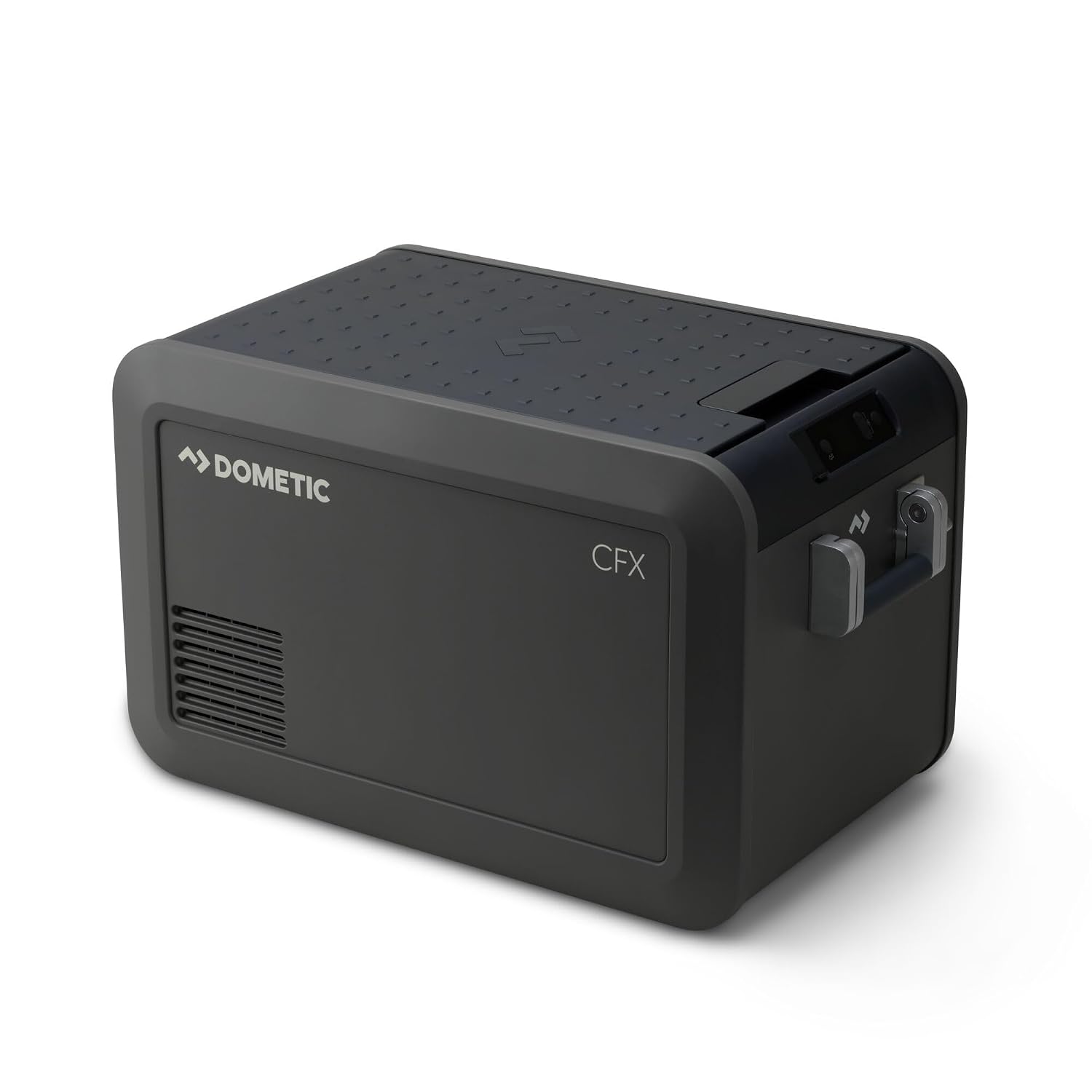
Dometic CFX5 35
- Price
- about C$1,307 as of September 2026
- Capacity
- 35 L (about 50 cans)
- Type
- Compressor fridge/freezer
- Weight
- 36.6 lbs (16.6 kg)
- Size
- 27.32 × 15.67 × 16.02 in
Fit note: Heaviest of the four at 36.6 lbs empty — slide it into the sleeper and leave it there instead of hauling it daily.
The CFX5 35 is Dometic’s current flagship portable fridge — it replaced the older CFX3 35, which is discontinued. If you see a CFX3 35 still listed somewhere, skip it and buy the CFX5. As of September 2026, the CFX5 35 is listed on Amazon.ca (currently sold by a third-party seller, so the price and seller may vary).
Why it scores highest: vacuum-insulated panels, a variable-speed compressor that sips power (Dometic says under 60 W), temperatures from 10°C down to −22°C, app control, and a 5-year warranty. Buyer reviews consistently rate the CFX line as the most reliable portable fridge you can buy. The downside is the price — this is a buy-it-for-a-decade purchase, not a casual one.
Good for: drivers who live in the truck and want the best reliability money can buy.
Pros
- Reliability: buyer reviews rate the CFX line the most reliable portable fridge you can buy
- Freezing: true freezer — holds from 10°C down to −22°C
- Efficiency: variable-speed compressor sips power (Dometic says under 60 W)
- Warranty: 5-year warranty, the longest of the four
Cons
- Price: the priciest of the four — a buy-it-for-a-decade purchase, not a casual one
- Weight: heaviest of the four at 36.6 lbs empty — slide it into the sleeper and leave it there
- Seller: currently listed on Amazon.ca by a third-party seller, so price and seller may vary
Best mid-range
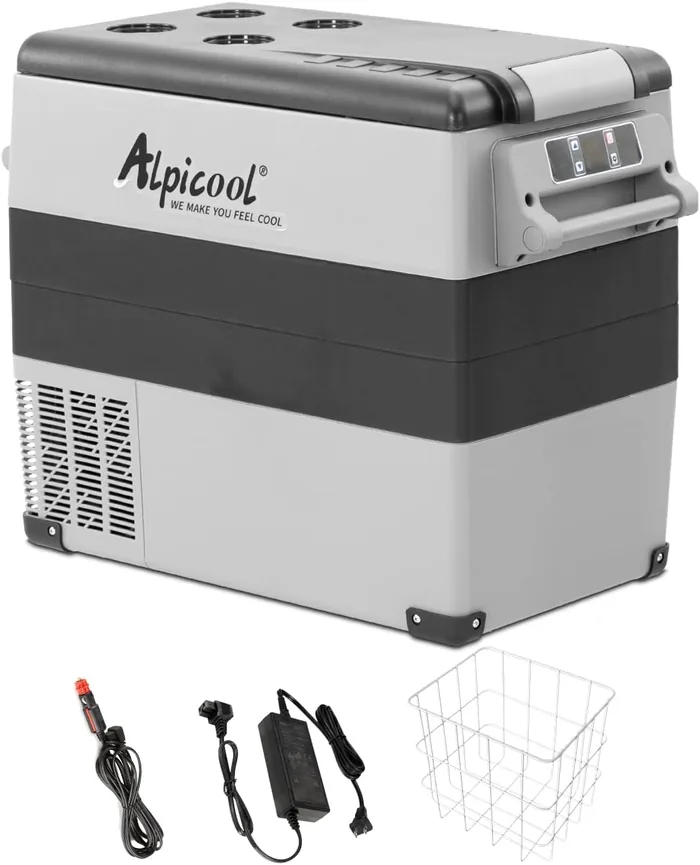
Alpicool CF55
- Price
- about C$360 as of September 2026 (currently a limited-time deal price, down from C$399.99 — it may change)
- Capacity
- 52 quarts, about 49 L (roughly 70 cans)
- Type
- Compressor fridge/freezer
- Weight
- 35 lbs (15.9 kg)
- Size
- 27.2 × 13.6 × 20.6 in
Fit note: 35 lbs empty — the heaviest budget compressor pick; plan where it rides in the cab before you lift it up the stairs.
The CF55 is the value play in large compressor coolers: about 49 litres for roughly a third of the Dometic’s price. It cools down to −20°C, runs on 12/24V DC and household AC, has a battery-protection cutoff, and includes a basket and LED light. Buyer reviews are strong for the price — 719 Amazon.ca ratings — with the most common complaints about the app and the thinner insulation compared to premium brands.
Good for: drivers who want maximum capacity per dollar and can live without the premium badge.
Smaller sibling: Alpicool also makes a 25-quart dual-zone version — same compressor tech in a shorter box that fits better behind the seats. Worth a look if 52 quarts is more cooler than your cab needs.
Pros
- Capacity per dollar: about 49 litres for roughly a third of the Dometic’s price
- Freezing: true compressor fridge/freezer — cools down to −20°C
- Extras: battery-protection cutoff, basket, and LED light included
Cons
- Insulation: thinner than premium brands, per the most common buyer complaints
- App: the app is the other common complaint in buyer reviews
- Size: 35 lbs and 27.2 in long — plan where it rides in the cab before you lift it up the stairs
Best budget compressor
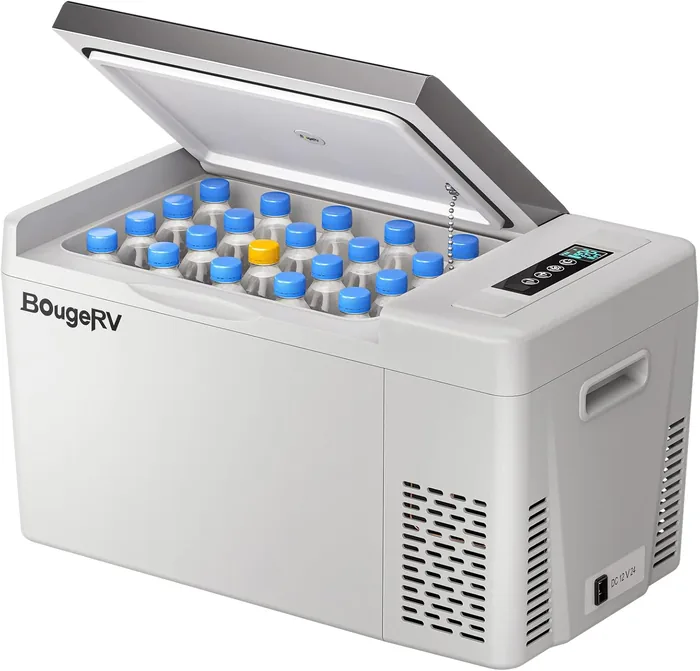
BougeRV 23 Quart
- Price
- about C$230 as of September 2026
- Capacity
- 23 quarts, about 22 L (about 30 cans)
- Type
- Compressor fridge/freezer
- Weight
- 22.27 lbs (10.1 kg)
- Size
- 22.68 × 12.6 × 12.97 in
Fit note: Lightest compressor pick at about 22 lbs — easy to move between the cab and the sleeper one trip at a time.
If you want a true compressor fridge — one that actually freezes — at the lowest price, this is it. The 23-quart BougeRV cools from about 25°C down to freezing in about 15 minutes, runs on 12/24V DC or AC, and has three-level battery protection. It holds around more than 2,500 Amazon.ca ratings. One caution: Amazon currently flags this listing as a frequently returned item, so it’s worth reading recent reviews before buying. The 22 L capacity is the tradeoff: enough for drinks, sandwiches, and a day or two of food, but not a full grocery run.
Good for: drivers who want real refrigeration on a budget and don’t need huge capacity.
Pros
- Price: the lowest-price true compressor fridge here
- Speed: cools from about 25°C to freezing in about 15 minutes
- Weight: lightest compressor pick at about 22 lbs — easy to move between cab and sleeper
- Battery protection: three-level battery protection built in
Cons
- Capacity: 22 L fits drinks, sandwiches, and a day or two of food — not a full grocery run
- Returns flag: Amazon currently flags this listing as frequently returned — read recent reviews before buying
Best Canadian thermoelectric
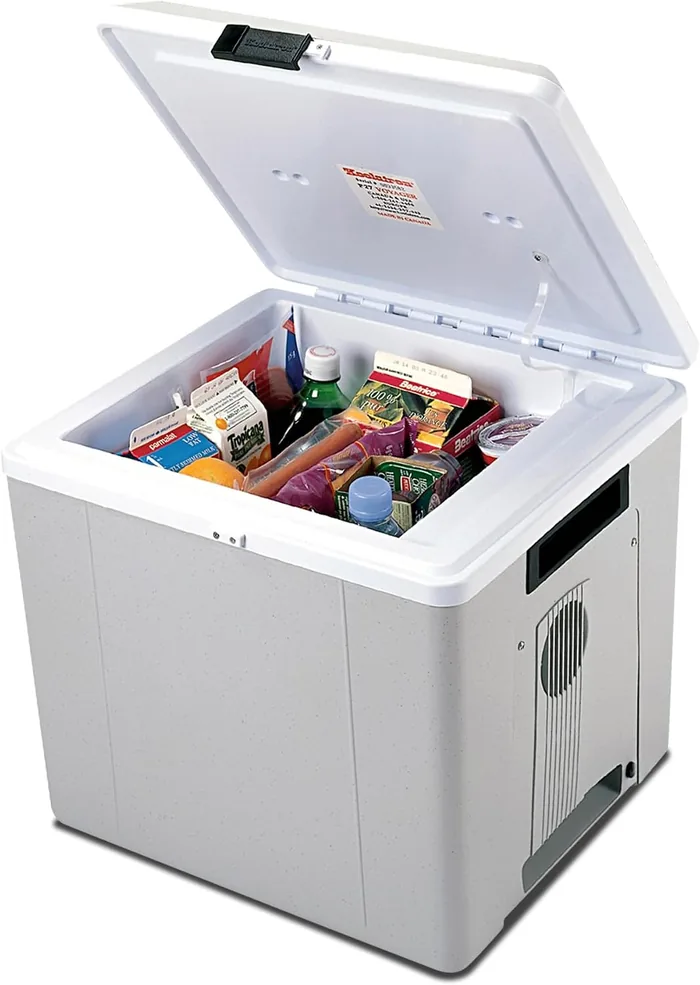
Koolatron P27
- Price
- about C$195 as of September 2026
- Capacity
- 29 quarts, about 27 L (about 48 cans)
- Type
- Thermoelectric cooler/warmer
- Weight
- 11.1 lbs (5.0 kg)
- Size
- 17.25 × 15.25 × 15.25 in
Fit note: Only 11 lbs — light enough to carry into the cab one-handed with your other hand on the rail.
Koolatron is a Canadian company, and the P27 is its classic 12V cooler — it also warms food, which the compressor models don’t do. It cools to about 22°C below ambient temperature, so it works well in mild weather but struggles in real summer heat. Simple, tough, no compressor to fail, and cheap to run at about 60 W. Buyer reviews average about 870 Amazon.ca ratings — owners like the simplicity and the warming function; the cooling limit in hot weather is the main complaint.
Good for: drivers who want a simple, affordable cooler for drinks and lunches, mostly in cooler months.
Pros
- Warming: cools and warms food — the compressor models don’t warm
- Weight: 11.1 lbs, the lightest of the four — carry it one-handed
- Simplicity: no compressor to fail; made by a Canadian company
- Price: the cheapest of the four at about C$195
Cons
- Cooling limit: thermoelectric cools to about 22°C below ambient — struggles in real summer heat
- No freezing: a cooler/warmer, not a fridge/freezer — it can’t freeze
Accessories
Complete the Setup
The cooler is only half the setup. Three cheap accessories make it work in a real cab:
Fused 12V splitter — one outlet becomes two or three without overloading the circuit, so the cooler is not fighting your charger.
Insulated cooler cover — a padded jacket for the box that cuts compressor runtime, especially in winter.
12V extension cable — for when the only live outlet is on the wrong side of the cab.
Tech choice
Compressor vs Thermoelectric: Which Do You Need?
| Compressor | Thermoelectric | |
|---|---|---|
| Cools to | Freezing (−20°C or lower) | ~20°C below air temperature |
| Works in summer heat | Yes | Weakly |
| Warms food | No | Yes (most models) |
| Price | C$230–1,310+ | C$140–230 |
| Best for | Groceries, multi-day runs | Drinks, lunches, mild weather |
Battery math
Will It Drain Your Batteries Overnight? Run the Numbers
Want the actual numbers? Our 12V cooler battery-drain calculator estimates how long your cooler can run with the engine off — pick your cooler, the weather, and your battery bank size.
Before your first overnight with a cooler plugged in, check your 12V outlet: know the fuse rating, what else shares the circuit, and whether the outlet stays live with the key off. Our 12V outlet safety guide walks through the two limits that matter.
Winter
Minus 40 Changes the Math
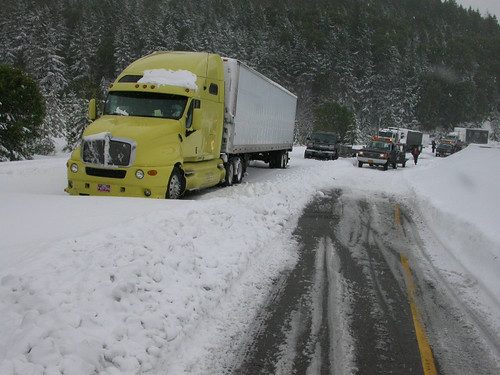
In deep cold the compressor barely runs, but lead-acid batteries lose much of their usable capacity too — the calculator already assumes that. A compressor cooler with real insulation is the only type that holds safe temperatures on northern winter routes. Read the minus-40 winter check.
The most reliable portable fridge you can buy.
What Amazon.ca owner reviews consistently say about the Dometic CFX line
Infographic
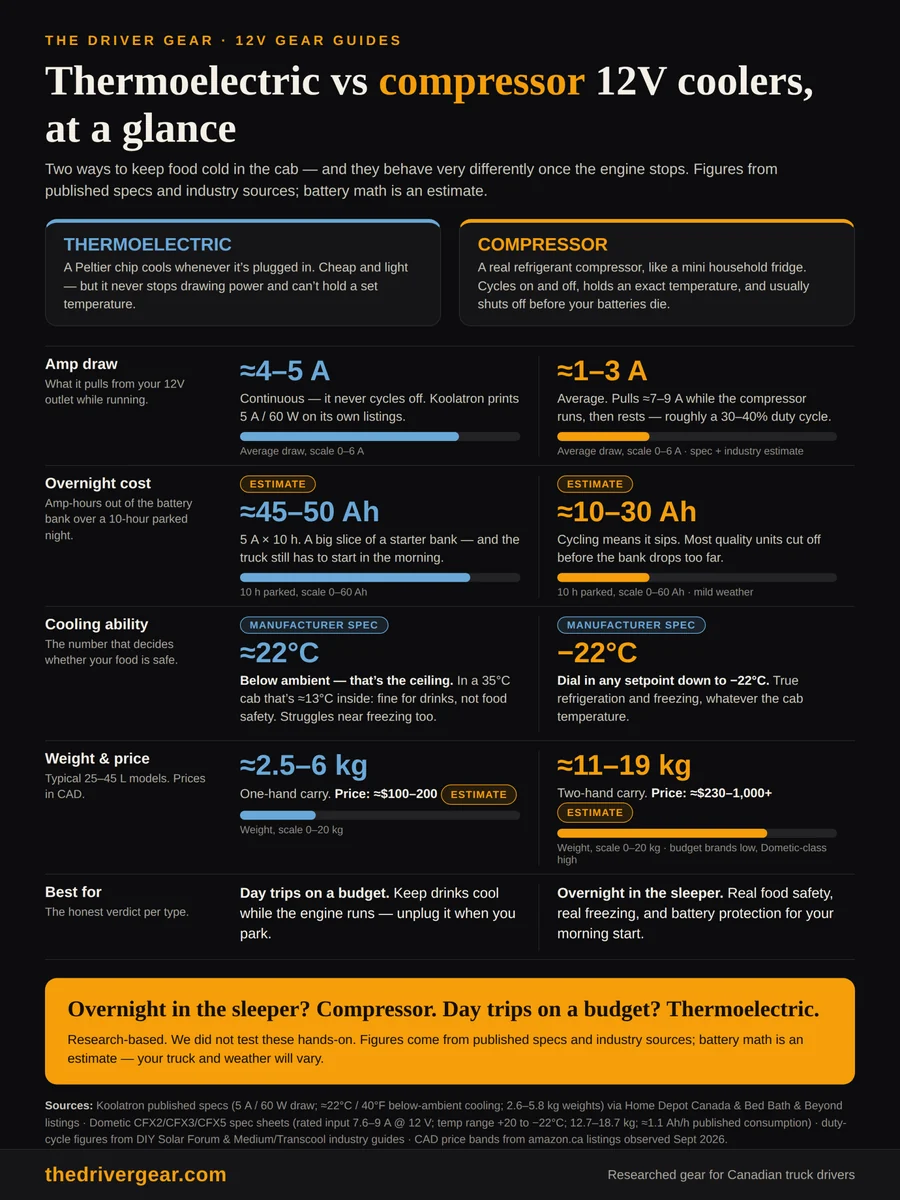
Thermoelectric vs Compressor, at a Glance
Battery protection
Set the Low-Voltage Cutoff Before Your First Night Out
Every compressor fridge in this guide — the Dometic CFX5 35, the Alpicool CF55, and the BougeRV 23 Quart — has battery protection built in: a low-voltage cutoff with sensitivity settings, usually labelled High, Medium, and Low. It watches your truck’s supply voltage, and when the voltage sags to the cutoff point, it shuts the compressor down before your batteries drop too far to crank the engine in the morning.
The setting is a trade-off, not a quality rating. High is the most protective — it cuts off earliest, so it is the right choice in winter, when a cold engine needs every amp, and whenever you park unplugged overnight. Medium is the everyday middle ground for a healthy battery bank in mild weather. Low lets the fridge run the longest, but it drains your batteries the deepest — use it only if you know your bank can take it and the truck starts easily.
Thermoelectric coolers like the Koolatron P27 do not have this protection at all: they draw power continuously with no cutoff, which is exactly why they are the risky choice for all-night runs. If you run a thermoelectric overnight, unplug it before you sleep. For the actual overnight numbers on your setup, run your cooler and battery bank through our battery-drain calculator.
Power setup
Socket or Hardwire: Feed the Fridge Properly
The cigarette-style 12V socket is fine for a thermoelectric cooler and for smaller compressor fridges — but a compressor draws a brief surge of current every time it kicks on, and that surge is where cheap connections fail. If the fridge’s plug feels warm to the touch after an hour of running, the connection is undersized or loose, and a warm plug today is a melted plug eventually.
The reliable fix is to hardwire: run heavier-gauge wire from the fridge straight to a fused connection at the fuse panel or battery bank, with an inline fuse sized to the fridge’s rating, and keep the factory plug as a backup for other trucks. It is a one-afternoon job that removes the weakest link in the whole setup.
Two more habits that matter. First, keep the vents clear — a fridge wedged tight against the sleeper wall with no airflow works harder, draws more, and dies sooner; give it a couple of centimetres on every vented side. Second, if the truck stop offers shore power, plug the fridge into AC overnight and let your batteries rest — every compressor pick in this guide runs on household AC as well as 12/24V DC. Read our 12V outlet safety guide before you commit to a wiring plan.
Sizing
One Zone or Two: Match the Fridge to Your Week
A single-zone fridge holds one temperature: it freezes or it chills, never both at once. That is plenty if you restock every day or two, run mostly drinks and sandwiches, or sleep at home most nights. Most drivers do not need more.
Dual-zone models add a second compartment with its own temperature, so frozen meals can sit at freezer temperatures on one side while drinks and fresh food stay chilled on the other. For drivers out five days or more, that is the difference between one grocery stop and a week of truck-stop food. The BougeRV line includes a 25-quart dual-zone version (mentioned under our budget pick) for cabs where 52 quarts is too much box.
Do not pay for zones you will not use: a dual-zone fridge costs more, and the freezer side eats into the capacity you could have used for cold storage. If you never carry frozen food, a single zone is cheaper, simpler, and lighter for the same footprint. Still torn on capacity? Our 35L vs 45L sleeper-cab guide walks through the size decision.
Counterpoint
Dorm Fridge on an Inverter vs 12V Cooler: The Honest Math
This question comes up on driver forums every few weeks: why spend C$300-plus on a 12V cooler when a basic compact fridge costs less than a tank of fuel? It is a fair challenge, and the honest answer is that if you already have a suitable inverter installed, a dorm fridge can genuinely be the better buy — more interior space per dollar, a freezer compartment that actually freezes, and no 12V-socket limitations. But if you do not already have the inverter and the battery bank to feed it, the 12V cooler wins on total cost and simplicity. Here is how the two compare.
| Dorm fridge on an inverter | 12V compressor cooler | |
|---|---|---|
| Typical price | ~C$80–150 for a 1.7–3.2 cu ft compact | ~C$230–400 for the picks in this guide |
| Nameplate power | ~90W (Insignia 1.7 cu ft: 115V / 1.5A on the label) | 36–45W (BougeRV 30 qt: 36W ECO / 45W MAX) |
| Overnight drain, 10 h parked (estimate) | ~40–50 Ah once inverter losses are included | ~10–30 Ah |
| Inverter needed | Yes — size it for the compressor startup surge | No — plugs straight into 12V |
| Portability | Stays in the truck — bulky to move | Carries between trucks and cars easily |
| Best when | A big inverter is already installed | No inverter; simple 12V setup |
The battery math, in plain numbers. A 90W dorm fridge does not draw 90W all night — the compressor cycles, so call it roughly half that on a mild night: ~45W of AC. The inverter itself is ~85–90% efficient, so the battery bank supplies around 51W, or about 4.2 amps at 12V. Over a 10-hour parked night that is roughly 42 amp-hours — plus whatever the inverter draws just sitting idle, which adds up if you leave it on 24/7. Assumptions: mild weather, fridge already cold, ~50% duty cycle.
A 12V compressor cooler rated 36–45W, on the same ~50% duty cycle, averages ~20W — about 1.7 amps, or roughly 17 amp-hours over the same 10 hours, which lines up with the ~10–30 Ah estimate used elsewhere in this guide. No inverter losses, no idle draw, no surge to plan for. That is why our picks are all 12V coolers: most drivers do not have a big inverter, and a cooler keeps the electrical side dead simple.
Two gotchas decide the dorm-fridge case. First, the startup surge: a compressor pulls several times its running watts for a split second when it kicks on — budget 3–5× the nameplate when sizing the inverter, which usually means a 1,000W+ inverter for a compact fridge. If you have to buy that inverter plus wiring, the savings over a 12V cooler evaporate. Second, a dorm fridge is not portable and does not freeze properly in a vibrating, tilting cab the way its freezer compartment promises at home — while a dual-zone 12V cooler can hold frozen food on one side and fresh food on the other in the same box.
If you already run a proper inverter for a microwave or TV, check our inverter sizing guide to confirm it has headroom for the fridge’s surge — and plug your battery bank into our battery-drain calculator to see whether your overnight setup survives a 10-hour parked stretch. If the numbers work, the dorm fridge is the honest pick. For everyone else, a 12V compressor cooler is still the simplest way to keep food cold in the bunk.
FAQ
12V Cooler Questions, Answered
Will running a 12V cooler drain my truck batteries overnight?
A compressor fridge draws power in cycles — typically a few amps when the compressor runs, near zero between. On a healthy battery bank it runs fine overnight. Set the low-voltage cutoff on the fridge so it shuts off before your starting batteries get too low. Thermoelectric coolers like the Koolatron draw continuously and are riskier for all-night runs. For the full breakdown, see our 12V outlet safety guide.
Can a thermoelectric cooler keep food cold at minus 20°C?
No — and neither can a compressor fridge do the impossible. Thermoelectric coolers only cool a fixed amount below the surrounding air, so in a frozen cab they are nearly useless. If you run northern winter routes, a compressor unit with real insulation is the only option that holds safe temperatures.
12V socket or hardwire — which is better for a fridge?
The cigarette-style 12V socket is fine for thermoelectric coolers and smaller compressor fridges. The Dometic CFX5 35 draws more when the compressor kicks on, so a direct-wired fuse box connection with heavier-gauge wire is more reliable and avoids melted plug tips. Check the 12V outlet safety guide before you commit.
How do I clean a 12V cooler between hauls?
Unplug it, pull the baskets, and wipe the interior with warm water and baking soda — never hose it out. Dry it fully with the lid open before storage or mildew moves in. Thermoelectric coolers with a fan vent need the dust brushed off the vents every few weeks so they do not overheat.
Can I fit a 12V cooler between the seats in my cab?
Measure your cab floor before buying. The Koolatron P27 is the slimmest of the four and fits most day-cab gaps. The Alpicool CF55 and Dometic CFX5 35 are chest-style and usually need the space behind or beside the passenger seat. Allow a couple of centimetres of clearance around the vents for airflow.
Compressor or thermoelectric — what is the real difference?
A compressor fridge works like a real fridge: it holds a set temperature down to freezing in any weather. A thermoelectric cooler only cools below ambient and draws power constantly. Compressor costs more up front but protects food on long, hot, or winter runs. Our picks cover both types so you can match your route.
How This Guide Was Made
Research-based. We did not test these hands-on. Scores come from published specs and driver reviews.
We compared 12V portable coolers sold on Amazon.ca using manufacturer specifications, published feature lists, and buyer review ratings as of September 2026. We did not physically test these products. Scores are our own, out of 20, based on cooling performance, capacity for the price, power efficiency, battery protection, and owner satisfaction. Prices were checked on Amazon.ca in September 2026 and will change — the link shows the current price.
Keep reading