Research · Failure modes
Why Heated Seat Cushions Fail in Real Trucks: 7 Failure Modes from 3-star Reviews
Short answer: the wiring gives up first. We dug through buyer-review aggregates, a component teardown, and years of repair-forum threads to find out what actually goes wrong with 12V heated seat cushions — and the pattern is brutally consistent. Thin wires, weak plugs, shutoff timers built for commutes, and universal-fit sizing that was never designed for a truck seat. Here is what breaks, why it breaks, and how to buy one that survives a winter.
Research-based. We did not test these hands-on. Findings come from published specs, buyer-review aggregates, repair teardowns, and driver forums. This article contains affiliate links to Amazon.ca. As an Amazon Associate I earn from qualifying purchases. Prices are approximate, in CAD, and change often — check the live listing before you buy.

Key Takeaways
- Wiring fatigue is the number-one killer. Climbing in and out, shifting weight, and bouncing down rough roads flexes the heating wires thousands of times. The thinnest point fails first — and in series-wired pads, one break kills the whole cushion.
- The plug dies before the pad. Review after review describes the 12V plug or the switch wiring failing within weeks, while the heating element itself was fine.
- Timers are built for cars, not long-haul shifts. A cushion that shuts itself off every 45 to 90 minutes is a constant annoyance across a driving day.
- Heat you cannot trust is worse than no heat. Cheap pads have burned holes in themselves and scorched drivers — while others never reach the temperature printed on the box.
Heated seat cushions are one of the cheapest winter upgrades a driver can buy — and one of the most returned. The five-star reviews all say the same thing: warm, fast, love it. The three-star reviews tell the real story, because they come from people who liked the idea and lived with the product long enough to watch it fail. We read a buyer-review aggregate for one of the best-selling 12V cushions (hundreds of reviews, via thereviewindex.com), a full component teardown by Solarbotics, and repair threads from Ranger5G, IH8MUD, TypeAccord, Bimmerforums, and Volvo forums. Seven failure modes kept repeating. They are not random defects — they are the design of the category.
Failure mode 1
The Wires Snap Where You Sit
This is the big one, and a teardown proves it. Solarbotics pulled apart an inexpensive 12V seat heater pad that had stopped working and found the failure exactly where physics says it should be: the internal wires had dried-out PVC jackets that cracked, and the wires kept flexing at those cracks until they snapped. A seat is a soft frame — the wires inside move with your body on every bump, and they endure brutal thermal cycling as the pad heats and cools through a Canadian winter. It is, in their words, “a situation ripe for a malfunction.”
What makes it fatal instead of annoying is how these pads are wired. Heating elements in seat pads are commonly wired in series, so a single break anywhere in the loop kills the entire pad. As one forum member put it on a Land Rover board, “if either element fails then both will stop working” — and on a Ranger forum, another wrote that “sitting in the seat is going to work the wires, and if there is a weak point, that constant in and out of the seat is going to cause problems later.” A Honda owner who stripped his seat found the broken wire “right at the front of the seat where it curved round at the front, clearly a spot with high stress.” High-stress fold points are where every pad fails first.
Worse, the break is often invisible. A Subaru owner who repaired his own elements discovered “hotspots where the heater element clearly got hotter than it should — and had singed the foam,” and found that some breaks “won’t necessarily be visible — because the heater wire is encased in a thin, very tough insulation.” The wire had snapped inside intact insulation. Your cushion dies with no visible damage at all.
Failure mode 2
The 12V Plug and Switch Die Before the Pad
In the Sojoy 12V cushion review aggregate, the most repeated complaints were not about the heating pad at all — they were about the connections. “Used it for 2 weeks then the wires connecting to the car adapter broke.” “The plug-in end popped apart in less than 2 months.” “After just one week of use, bare wires became exposed at the switch!” “Broke in one month. Lights went out, I changed the fuse and it still did not work.” “Crapped out after two nights, returned.” The heating element was usually fine. The twelve-dollar plug assembly was not.
This is the failure mode most buyers never consider, because the listing photos show a thick, reassuring cable. But that cable gets yanked every time the driver slides out of the seat, and the strain relief on budget cushions is decorative at best. The Solarbotics teardown found a “sketchy activation switch” — a pressure switch that passes full power straight to the heating coils when you sit down, with no relay and, notably, no thermal reset fuse. The cheapest part of the product carries the full electrical load with no protection behind it.
A related switch failure shows up in car forums too: on a BMW board, owners describe the heat switch turning itself off after about three seconds of operation — a bad resistor in the switch, not the element. When your cushion misbehaves, the element gets blamed and the switch walks free.
Failure mode 3
Dead Zones: Half the Cushion Quits
Not every failure is total. A common 3-star pattern is partial heating: the backrest warms up but the seat bottom stays cold, or one side of the pad goes dead. On a BMW forum, one owner wrote that “the only piece that still works is the back portion” — diagnosed by another member as the seat-bottom element, which takes the most abuse. Because the seat bottom carries your full weight on every bump, its element always fails first.
Drivers notice this asymmetry sooner than car commuters do. A Volvo owner observed that his driver’s seat heater degraded faster than the passenger’s, reasoning that “the drivers seat gets more cycles on it and perhaps the more constant flexing would in some way affect the connections.” For a truck driver who lives in one seat for the entire shift, “more cycles” is an understatement — the driver’s pad ages in dog years. If your cushion heats unevenly after a month, that is not a quirk. It is failure mode 1 arriving in stages.
Failure mode 4
The Timer Was Designed for a Commute, Not a Shift
Many 12V cushions ship with an auto-shutoff timer — the Sojoy’s product name literally includes “45 Minute Timer,” and one roundup of the Canadian market found cushions offering 30, 60, and 90-minute intervals. For a car commuter, a timer is a safety feature. For a driver on a long haul, it is a design flaw: the cushion quietly shuts off mid-shift, and you get to lean forward and stab the button again, several times a day, all winter.
The deeper problem is that most listings never publish the timer behaviour at all. In our own heated seat cushion buying guide, we found that not one cushion we could verify publishes a shutoff timer or its wattage — so buyers discover the timer on the highway, not on the product page. And some drivers respond by running the cushion on high to “bank” heat before the timer kills it, which accelerates every other failure mode on this list.
Failure mode 5
Too Hot to Trust, Too Cool to Matter
This is the failure mode with real consequences. On a UK parenting forum, a member warned others to “go careful with the cheaper aftermarket alternative ones” after an elderly neighbour burned himself on an overheating pad on the M4 motorway — he could not even pull over to switch it off. Another member wrote that her cheap pad “worked great until it burned a hole in itself.” These are not freak incidents: in 2006, the Elegant Ortho Heated Seat Cushion sold at Canadian Tire (product #32-1425) was recalled after units were found to have a manufacturing defect “that can lead to overheating, causing the seat cushion to smoke.”
Remember the Solarbotics teardown: the cheap pad they opened had no thermal reset fuse. Its “safety system” was a pressure switch that dumps full power to the coils whenever someone sits down. When the only thing between you and a runaway heating element is a switch that costs cents, “overheat protection” on the listing is a claim, not a feature.
The other end of the spectrum is just as dishonest. A verified buyer of a Zone Tech cushion measured his pad at 53°C against a claimed 65°C maximum — and it took ten minutes to get there. Our buying guide found the same pattern: listings advertise “multiple heat levels” with no published temperatures, so “high” can mean anything. A cushion that cannot be trusted on high and cannot be felt on low has failed at its only job.
Failure mode 6
It Was Never Sized for a Truck Seat
Almost every heated cushion on Amazon is a universal-fit car product. Truck seats are wider, taller, and — critically — they move on air suspension. The mismatch shows up in reviews constantly. One Canadian roundup flagged a popular pad at just 14.25 × 14.5 inches, noting “it may not cover your entire car seat” — let alone a truck seat. Seat-only pads with no backrest heating miss half the benefit for a driver whose back is pressed against cold vinyl for hours.
Then there is the mounting. “The straps are elastic and will easily wear out.” “Straps broke after a few weeks.” When the straps go, the cushion migrates — and a heated pad bunched up under one thigh is worse than no pad at all. Cord placement is the other universal complaint: “the cord was annoying to manage over to the dash,” “wire management is a downer,” and one reviewer noted the cord “goes between your legs, making it easy to tangle.” In a truck, where the 12V outlet may be a full arm’s length from the seat, a short cord is not an inconvenience — it is a daily fight.
Failure mode 7
The Silent Battery Drain
A heated cushion draws far less than any plug-in cab heater — but it still draws, and in this category the exact number is a mystery. Our buying guide’s honest finding: no 12V heated cushion we could verify publishes its wattage or its auto-shutoff behaviour. That means a cushion left powered in a parked truck is an unknown load on your batteries, overnight, in the cold — exactly when batteries are weakest. Drivers who run the numbers on bigger 12V loads use our battery-drain calculator to see how fast an overnight draw adds up; a heated cushion deserves the same suspicion until its draw is published.
The fix is behavioural and free: switch the cushion off with the engine, every time, and never trust an unpublished timer to do it for you. Our 12V outlet safety guide covers what your sockets can actually run and which ones stay live with the key off — worth ten minutes before winter.
Buy it right
How to Buy One That Lasts
The failure modes above are a buying checklist in disguise. Here is what to look for.
Demand a real safety story. “Overheat protection” in a bullet point means nothing. Look for a described thermostat or thermal cutoff, a fused 12V plug, and published timer behaviour — what shuts off, and when. If the listing publishes none of this, assume none of it exists.
Inspect the plug and switch in the photos. Look for visible strain relief where the cable meets the plug and the controller — a tapered rubber collar, not a bare cable entering hard plastic. The reviews say the plug dies first; buy the one whose plug looks like it was designed by someone who has seen a truck cab.
Measure your seat, then the cushion. Get real dimensions and compare them to your truck seat — seat width, backrest height. Prefer full seat-plus-back coverage, elastic straps with a non-slip backing, and a cord long enough to reach your 12V outlet without draping across your lap.
Insist on named heat settings. Temperatures, not adjectives. “High/low” with no published temperatures is how you end up with the 53°C pad from failure mode 5. A listing that publishes actual temperatures is a listing that can be held to them.
Buy from a seller with a warranty and a pulse. A one- or two-year warranty and a seller that answers messages will not stop a wire from snapping — but it decides whether you get a replacement or a shrug. The Sojoy reviews are full of sellers who replaced dead units quickly; that support is part of what you are buying.
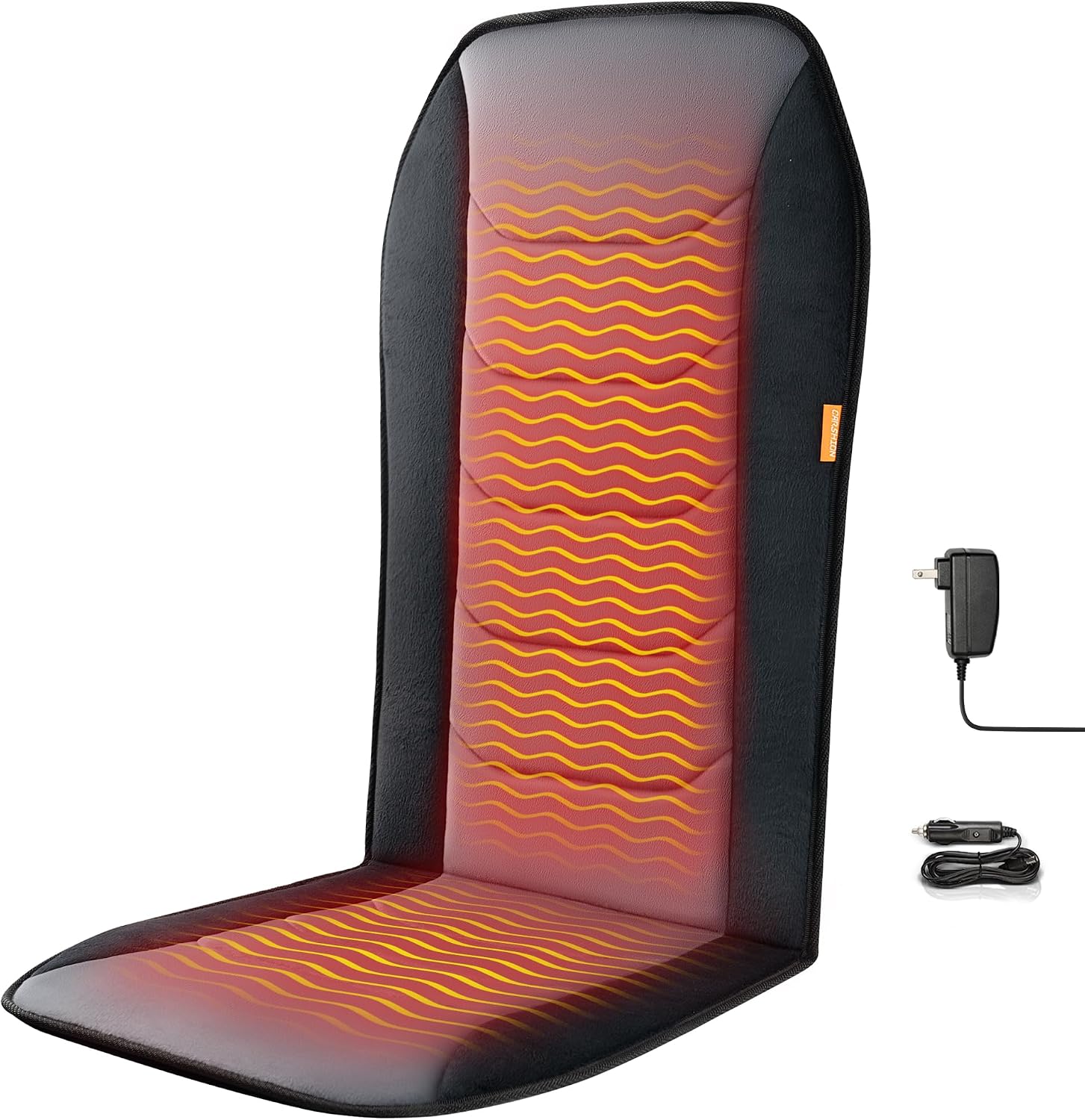
The only model in our heated seat cushion buying guide with a real review record, named heat settings, and full seat-plus-back coverage is the CARSHION — it is the pick we would buy against every failure mode above.
The honest case for
When a Heated Cushion Is Still Worth Buying
None of this means heated cushions are a scam. The idea is excellent — heating the driver directly instead of the cubic metres of cab air is the most efficient warmth per dollar in winter driving. The failures above are failures of cheap execution, not of the concept. A heated cushion is still worth buying when your truck’s factory heat is weak or broken, when you idle anyway and want comfort without touching the thermostat, for pre-heating the seat before a cold start, and through the shoulder seasons when full cab heat is overkill.
One rule covers all of it: retire the cushion at the first sign of damage. A pad with exposed wiring, a hot spot, a plug that needs wiggling, or a switch that behaves erratically is not a repair project — at this price, it is a replacement. The forums are full of owners who soldered a broken element back to life; admire their skill, then buy a new cushion.
FAQ
Heated Cushion Failure Questions, Answered
Why did my heated seat cushion stop working after a few weeks?
Almost always wiring fatigue. Sitting, shifting, and road vibration flex the thin heating wires until one snaps — and because pads are wired in series, one break kills the whole cushion. Check the plug and switch wiring first: reviews show the 12V plug assembly fails more often than the pad itself.
Can I repair a dead heating element?
Repair forums document owners finding the break with a multimeter and soldering it, sometimes successfully. But breaks are often invisible inside intact insulation, and a repaired pad has no safety margin left. On a sub-$100 cushion, replacement is the sane call — retire any pad with exposed wiring or hot spots immediately.
Is it safe to leave a heated cushion plugged in overnight?
No. No 12V cushion we could verify publishes its wattage or its auto-shutoff behaviour, so an overnight draw is an unknown load on cold batteries. Switch it off with the engine, every time. If you need overnight warmth, a heated blanket with a proper timer is the right tool.
Heated cushion or heated blanket for a truck driver?
Different jobs. The cushion works while you drive; the blanket works while you sleep. If you drive days through winter, take the cushion. If you sleep in the truck, take the blanket first — then add the cushion.
Do universal-fit cushions fit truck seats?
Sometimes, but check dimensions against your actual seat — truck seats run wider and taller than car seats, and air-ride movement punishes weak straps. Full seat-plus-back coverage with real published dimensions is the minimum. For the comfort side of the equation, our seat cushion guide covers support for long shifts.
How This Article Was Made
Research-based. We did not test these hands-on. Findings come from published specs, buyer-review aggregates, repair teardowns, and driver forums.
We investigated 12V heated seat cushion failures using buyer-review aggregates (including the Sojoy 12V cushion review analysis via thereviewindex.com and Zone Tech buyer reviews), a component teardown by Solarbotics, the Hardbacon Canada heated-seat roundup, repair threads from Ranger5G, IH8MUD, Disco3, TypeAccord, Bimmerforums, ultimatesubaru, and VolvoXC forums, a Mumsnet discussion of overheating incidents, and the 2006 Elegant Ortho recall archive. Research current as of September 2026. No product was tested hands-on; no scores are given because this is an investigation, not a ranking.
Sources: Solarbotics heated seat teardown · Sojoy 12V cushion review analysis · Hardbacon: car seat heaters in Canada · Mumsnet: heated cushion experiences · Ranger5G: heated seat failure thread · TypeAccord: intermittent heated seats · Bimmerforums: heated seat diagnosis · VolvoXC: driver’s seat heater · IH8MUD: dead seat heater repair · Disco3: heated seat diagnosis · UltimateSubaru: heated seat problem · 2006 Elegant Ortho recall notice (PDF)
Keep reading