Infographic
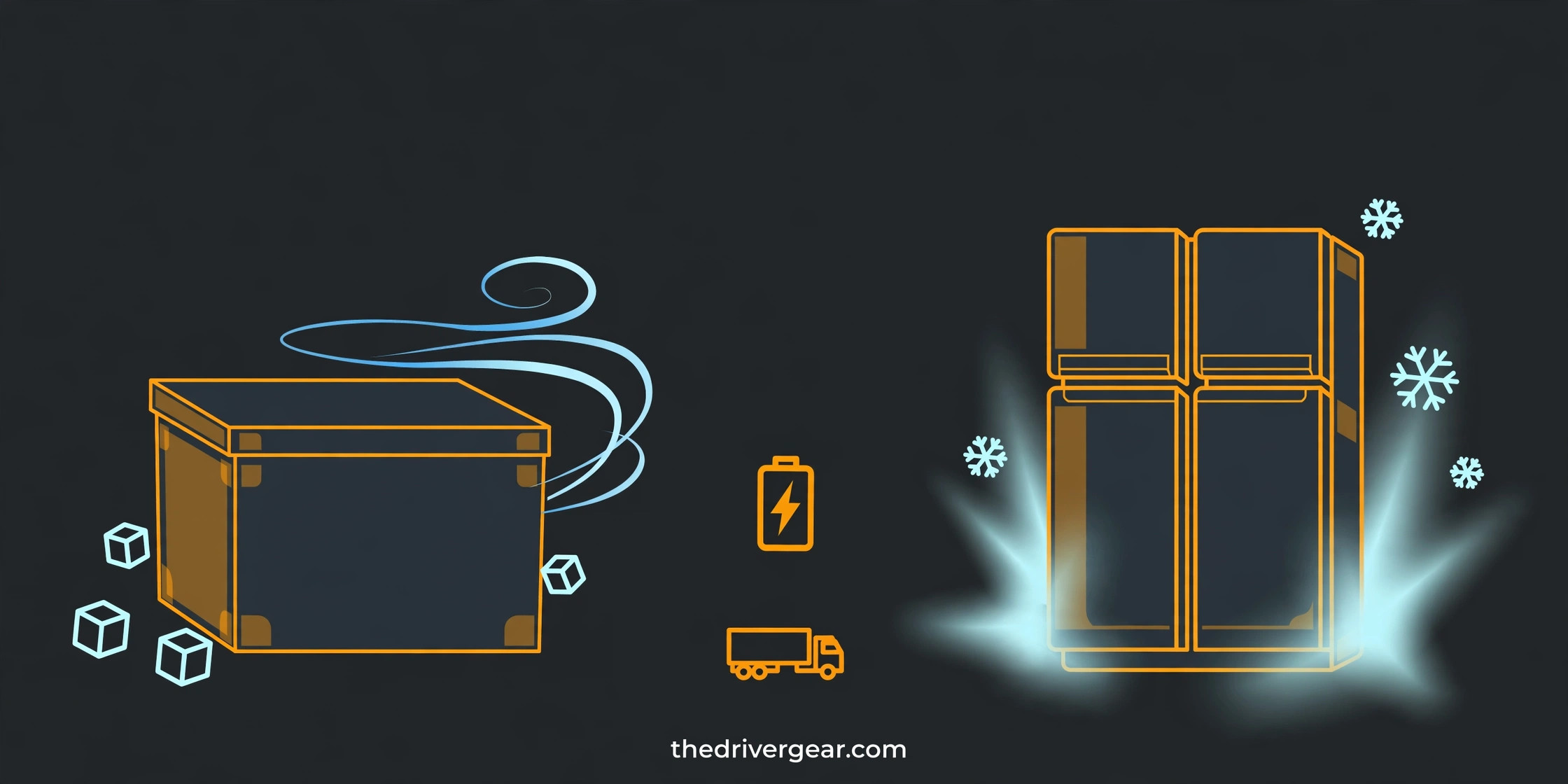
Thermoelectric vs compressor coolers: the infographic
Amp draw, overnight drain, and ice-cost math — the two 12V cooler technologies at a glance.
Research-based. We did not test these hands-on. Scores come from published specs and driver reviews.
Numbers
Amp draw: the honest numbers
| Measure | Thermoelectric | Compressor fridge |
|---|---|---|
| Draw while running | ≈ 4 A continuous (48 W at 12 V) — most budget models have no thermostat and run constantly | ≈ 4–5 A while the compressor runs (50–60 W), cycling roughly 25–35% of the time |
| Average draw, 25°C cab | ≈ 4 A | ≈ 1.0–1.5 A |
| Overnight drain, 10 h engine-off | 4 A × 10 h = 40 Ah — about 40% of a 100 Ah battery | 1.2 A × 10 h ≈ 12 Ah — about 12% of a 100 Ah battery |
| Cooling ability | 15–20°C below the cab — a 40°C cab means 20–25°C inside. Still warm. | Holds a real setpoint down to −18°C freezer territory, through heat waves |
| Typical price | $60–$150 CAD (as of Sep 2026) | $300–$500 CAD (as of Sep 2026) |
Money
Ice-cost math: when a compressor fridge pays for itself
Truck-stop ice runs about $3–$4 a bag in Canada. A regular cooler eats roughly two bags a day in summer — call it $7 a day. Run five days a week and that is about $150 a month in ice.
A compressor fridge at $300–$450 pays for itself in roughly 2–3 months of that ice habit — before counting the food you stopped throwing out. The full walkthrough is on our cooler vs truck-stop ice cost comparison, and the battery math behind the overnight row above lives in the overnight battery-drain guide.
Which one
When each type wins
- Thermoelectric wins — day cab or single shifts, drinks and packaged snacks only, mild temperatures, tight budget. Check our full thermoelectric vs compressor explainer before buying.
- Compressor wins — multi-day trips, real food, hot weather, overnight stops with the engine off. This is the serious option our 2026 cooler picks rank.
Transparency
Our assumptions (stated, not hidden)
- 12.6 V resting system voltage; a 12 V × 15 A dash circuit maxes out near 180 W.
- 25°C cab, compressor set to 4°C fridge mode, 30% duty cycle; thermoelectric models without a thermostat run continuously.
- Battery = 100 Ah deep-cycle equivalent, 50% usable for lead-acid; real trucks carry more reserve, cold starts eat margin.
- Ice at $3.50 a bag, two bags a day, five road days a week.
- Compressor figures reflect typical published specs for 35–45 L dual-zone models; small single-zone units can draw less.
Share
Embed this infographic
Forums, dispatch boards, and driver groups are welcome to share this page. Paste the snippet below — it links the artwork back here so the source travels with it.
Keep reading
Related reading
- Best 12V coolers for truck drivers (2026) — our ranked picks.
- 12V cooler battery-drain calculator — will it last the night?
- Best seat cushions for long hauls
- Buying guide hub
- New driver starter kit
- Truck driver gifts